Results 1 - 10 of 51 (Sorted by date)
Report Chapter
In Global Environment Outlook 7
Author:
Jacob Park
Susana Beatriz Adamo
Quosay Awad Ahmed
Ricardo O. Barra
Jonathan Davies
Rozana Himaz
Jinlong Liu
David Lopez-Carr
Indu K Murthy
Evans Osabuohien
Adina Manuela Relicovschi
Chao Ren
Roopesh Kevin Sungkur
Thomas F. Thornton
Chiara Varazzani
Samanta Villegas
Le Yu
A growing economy, increasing population and changing lifestyles are driving the demand for goods and services, such as materials, energy, and food. However, the current systems for producing and consuming these resources are unsustainable. They are shaped by poor governance structures and policies, particularly in the areas of economics and...
Report Chapter
In Global Environment Outlook 7
Author:
Catalina Turcu
Medani Bhandari
Simone Lucatello
Valerie Nelson
Sandra Torrusio
Sibel Eker
Paul Lucas
Audrone Telesiene
Achieving internationally agreed environmental, social and economic goals requires whole-of-government and whole-of-society approaches (established but incomplete). These approaches can transform interconnected economic and financial, energy, food systems, materials/waste and environmental systems. Such a transformation, in turn, requires...
Report Chapter
In Global Environment Outlook 7
Author:
Riya
Rahiman
Aliyu
Aliyu
Farshad
Amiraslani
Elliot
Boateng
Lindsay
Beevers
Erica
Gaddis
Maryna
Henrysson
Saleemul
Huk
Andrei
Kirilenko
Mahdi
Kolahi
Jyotsna
Krishnakumar
Govind
Kelkar
Tao
Lin
Maria Cristina
Tirado
Nomanesi
Madikizela-Madiya
Valerie
Nelson
Jaee
Nikam
Kamaljit
Sangha
Sandya
Gunasekara
Savio Rousseau
Rozario
The global environmental crises – climate change, biodiversity loss, land degradation and desertification, and pollution and waste – are damaging human well-being and hindering progress of the economic and social dimensions of all the SDGs. Addressing these crises is a prerequisite for achieving the SDGs. Therefore, environmental goals and targets...
Policy Report
Author:
Tamiru A. Abiye
Ana Paula Aguiar
Peter Alexander
Barbara Amon
Apoorva Arya
Ghassem Asrar
Lindsay Beevers
Medani Bhandari
Meena Bohara
Gillian Bowser
David C. Broadstock
Monday Businge
Donovan Campbell
Kateřina Černý Pixová
Lynette Cheah
Leila Dagher
Vassilis Daioglou
Jonathan Davies
Parfait M. Eloundou-Enyegue
Pierre Failler
Pedro Fidelman
Shinichiro Fujimori
Erica Brown Gaddis
Keisha Garcia
Elisabeth Gilmore
Sarah Green
Andres Guhl
Stephan Harrison
Gladys Cecilia Hernandez-Pedraza
Susie Ho
Min Hu
Madhav Bahadur Karki
Monica Kerretts-Makau
Indu K. Murthy
Mulako Kabisa
Mizanur Khan
Andrei Kirilenko
Kyung-Ah Koo
Jyotsna Krishnakumar
Joanna Kulczycka
Debora Ley
David Lopez-Carr
Paul Lucas
Clever Mafuta
Diego Martino
Sarah-Lan Mathez-Stiefel
Karina Miglioranza
Ruben Mnatsakanian
Rachid Mrabet
Kevin Nnanye Nwaigwe
Alice Odingo
S. Nadia Ouedraogo
Jacob Park
Jan Plesnik
Riya Rahiman
Adina Manuela Relicovschi
Henri Rueff
Aibek Samakov
Tek Sapkota
Heinz Schandl
Patrick Schröder
Jeff Seadon
George Florin Staicu
Paul Sutton
Gail Taylor
Audrone Telesiene
Catalina Turcu
Bruno Turnheim
Detlef van Vuuren
Sotiris Vardoulakis
Karen Helen Wiltshire
Xiyan Xu
Fang Yu
Pandi Zdruli
Despite global efforts and calls for action, our planet has already entered into uncharted territory, facing global environmental crises of climate change, biodiversity loss, land degradation and desertification, and pollution and waste. These interconnected crises, which are undermining human well-being and primarily caused by unsustainable...
Presentation
Clean Air Week 2025
Air pollution is Southeast Asia’s leading environmental health risk and a key driver of climate change through short-lived climate pollutants (SLCPs) such as black carbon and methane. The Southeast Asia Climate & Clean Air Initiative (SEACAI), co-financed by Germany and Switzerland, demonstrates how coordinated donor action can deliver tangible...
Peer-reviewed Article
In Sustainability
Author:
Fiona
Wyrtzen
Antonio
Meza
Ben
Snide
Katrina
Kasyan
Catherine
Burrow
Randall S
Guillory
Christopher Carl
Wilkins
David
Eaton
Many cities have integrated health co-benefits into their climate plans to address cost concerns and build multi-stakeholder support for resilient, net-zero transitions. While some studies have demonstrated that cities vary in how much they link health and climate, few have examined why this is the case. This study fills this gap by using 16...
Peer-reviewed Article
In Sustainability Science
Author:
Xerxes
Seposo
Kayo
Ueda
As more cities adopt resilient net-zero policies, local-level assessments of the current and future health impacts of warmer temperatures are becoming increasingly important. These assessments may be even more useful if they demonstrate how health impacts of different predicted temperatures vary across acclimatized/non-acclimatized groups. This...
Non Peer-reviewed Article
In 隔月刊 地球温暖化
Author:
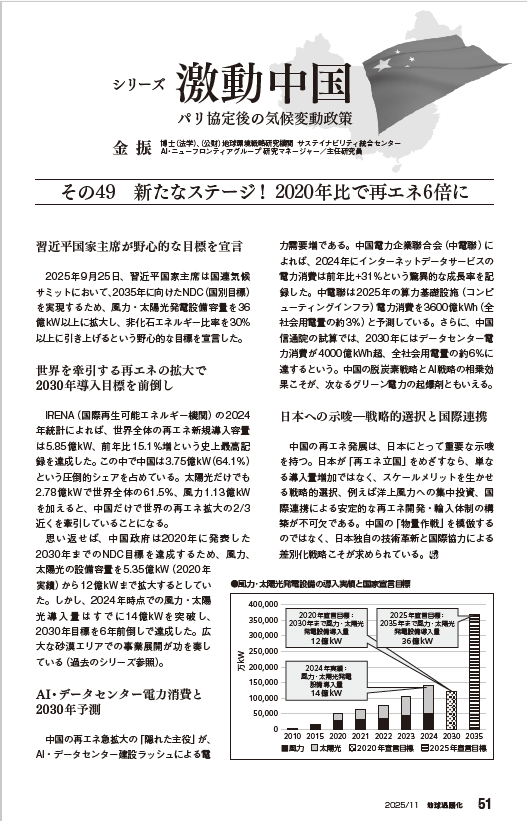
2025年9月25日、習近平国家主席は国連気候野心サミットにおいて、2035年に向けたNDC目標として、風力・太陽光発電設備容量を36億kW以上に拡大し、非化石エネルギー比率を30%以上に引き上げるという野心的な目標を宣言した。この目標は、単なる数値目標ではなく、中国がクリーンエネルギー転換において世界をリードする決意を示すものだ。
Presentation
日本環境教育学会 第 36 回年次大会(北海道)
近年、気候変動の深刻化に伴い、それを要因とする人の移動が世界各地で発生している。世界銀行の Groundswell 報告書(2021)によれば、2050 年までに 2 億 1600 万人が国内移住を余儀なくされる懸念が指摘されており、東アジア・太平洋地域では 4900 万人の国内避難民が発生する可能性があるとされる。しかし、気候変動のみが移動の直接的な要因ではなく、経済や教育といった複合的な要因が絡み合うため、その実態は把握が困難であり、国際的な難民・移民政策のギャップを生んでいる。本研究は、気候変動の影響を受けやすい太平洋島嶼国から、地理的に近接するオーストラリアとニュージーランドへの人の移動に焦点を当てる。これらの国は歴史的に労働力として太平洋島嶼国の人々を受け入れてきたが...
Peer-reviewed Article
In Current Opinion in Environmental Sustainability
Author:
Marco
Reggiani
Achieving the 2030 Agenda requires comprehensive follow-up and review across all levels of government. Although local governments play a critical role in implementing the sustainable development goals (SDGs), their current follow-up and review architecture — conceived from a global perspective and tailored to national reporting — ignores local...