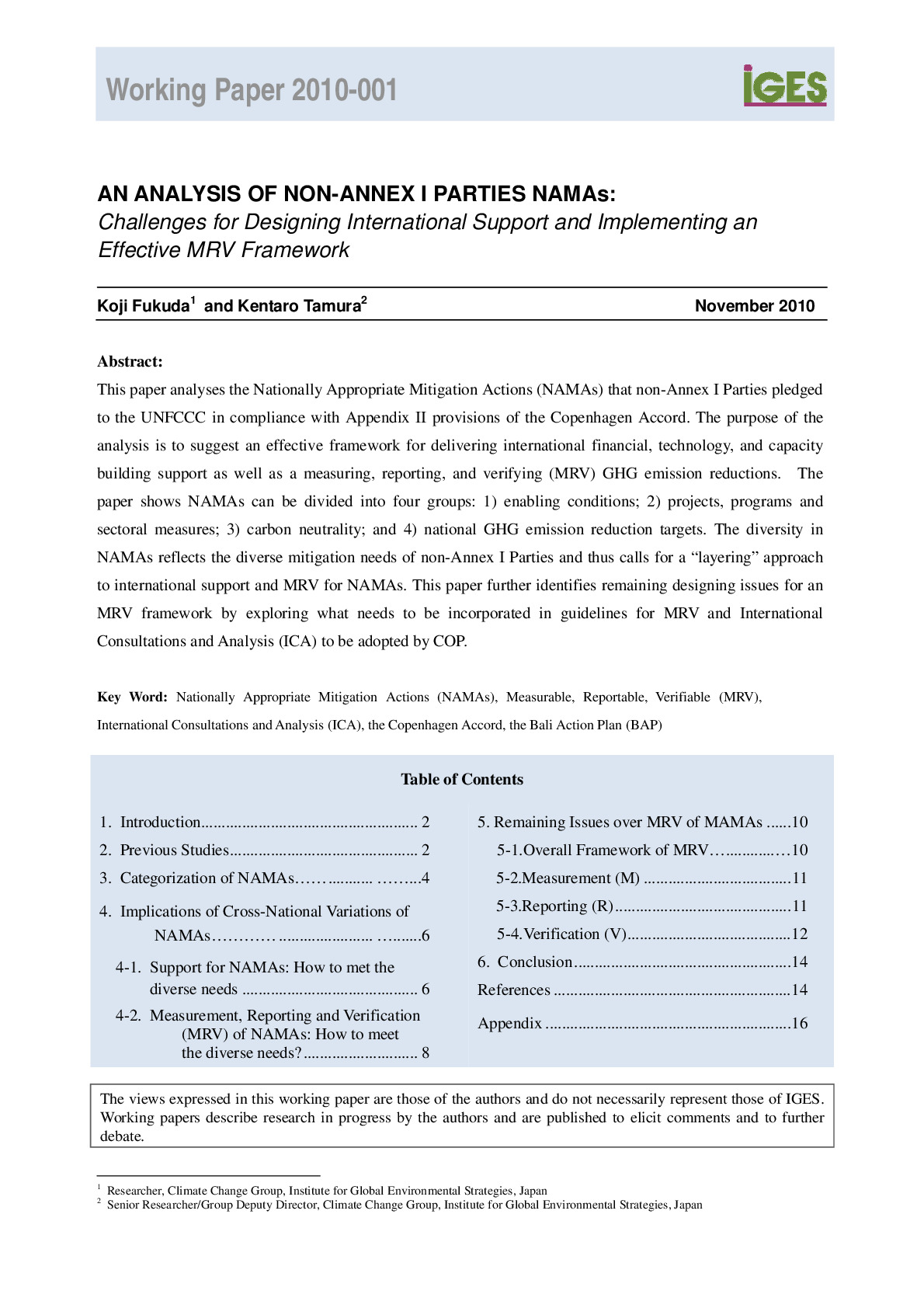
This paper analyses the Nationally Appropriate Mitigation Actions (NAMAs) that non-Annex I Parties pledged to the UNFCCC in compliance with Appendix II provisions of the Copenhagen Accord. The purpose of the analysis is to suggest an effective framework for delivering international financial, technology, and capacity building support as well as a...
- Clear all
- Language: (-) English
- Publication Year: (-) 2010
Results 21 - 30 of 208 (Sorted by date)
On 22 September 2009, Chinese President Hu Jintao spoke at the UN Climate Change Summit that “(China is) to significantly reduce CO2 emissions per GDP (CO2 intensity) from 2005 level by 2020”. Around the same time, a government-related think tank in China published scenario analysis report that provided actual numbers to support such CO2 intensity...
IGES Working Paper Series
Risk insurance can provide an effective means of catastrophic risk reduction and climate change adaptation in the developing countries. The ongoing discussions by the Conference of Parties to the United Nations Framework Convention on Climate Change are putting substantial efforts to promote climate change adaptation through international...
Presented for Better Air Quality (BAQ) 2010, Breakout Session held in Singapore, 9-12 November 2010.
ADB’s2ndJapan National Workshop on Economics of Climate Change and Low Carbon Growth Strategies in Northeast Asia
The fast growth of economy in developing Asian countries has caused various problems on the environment. Corporate environmental management (CEM) is still obviously poor and thus needs to be greatly improved. With aims to fill up the gap of policies encouraging better CEM, Kansai Research Centre, Institute for Global Environmental Strategies (KRC...
IGES Kansai Centre 2010 International Symposium
As a major component of the corporate environmental management (CEM) project conducted at Kansai Research Centre, IGES, during 2007-2009, environmental information disclosure (EID) is believed effective for promoting CEM by assisting in better communications of the firms and their related stakeholders like governmental agencies, investors...