
Results 5011 - 5020 of 6464 (Sorted by date)
Conference Proceeding

5th High Level Seminar on Environmentally Sustainable Cities Proceedings
Policy Brief
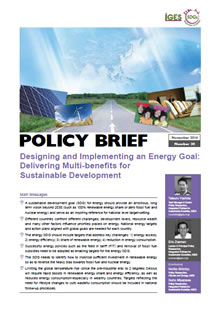
Since the Rio+20 meetings in 2012, policymakers and experts have engaged in nearly two years of discussion on Sustainable Development Goals (SDGs). This dialogue is expected to culminate in September 2015 with a post-2015 development agenda that will help frame how stakeholders can pursue development for the years ahead. The purpose of this policy...
Working Paper
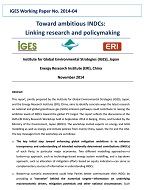
This report, jointly prepared by the Institute for Global Environmental Strategies (IGES), Japan, and the Energy Research Institute (ERI), China, aims to identify concrete ways the latest research on national and global greenhouse gas (GHG) emission pathways could contribute to raising the ambition levels of INDCs toward the global 2°C target. The...
Discussion Paper
Key messages: 1. Technological absorptive capacity (consisting of the factors of general governance and business climate, basic technological literacy, access to finance, and technologically proactive policies) is the key determinant of successful technology transfer. Access to finance is one necessary but insufficient condition for technology...
Working Paper
IGES Working Paper
Water and sanitation play an important role in the sustainable development and are central to all activities of human beings and for the health of the natural ecosystems. For the past several decades, water and sanitation, especially water sector, have been subjected to two kinds of pressures i.e. developmental pressure and climate change related...
Issue Brief
This paper focuses on East and South Asian countries, but does not include Pacific islands. The paper looks at two distinctive periods—the pre-fast start finance (pre-FSF) period (2006-2010) and the fast-start finance (FSF) period (2010-2012)—to track the different climate finance trends in Asia. The paper further identifies the countries as either...
Peer-reviewed Article
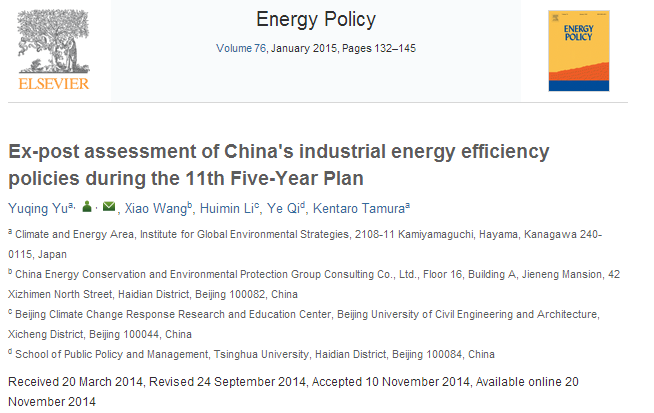
In Energy Policy
China implemented a package of policies during the 11th Five-Year Plan (2006-2010) to improve industrial energy efficiency. This assessment provides a methodology that establishes a causal relationship between policy implementation and energy conservation effects. To enhance the confidence in the research findings, this assessment applies two...
Peer-reviewed Article