Results 1 - 10 of 28 (Sorted by date)
Fact Sheet
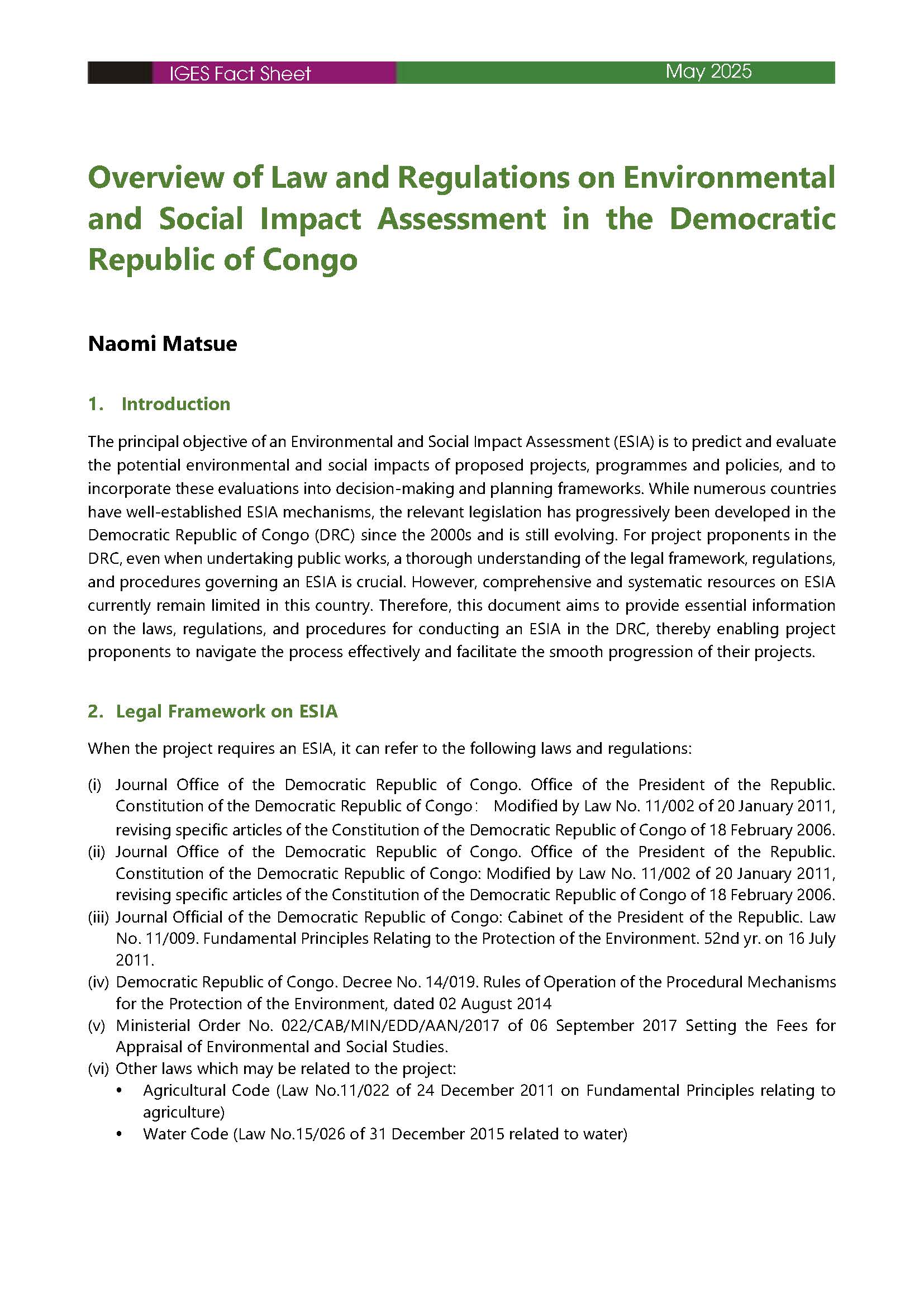
This document outlines the legal framework, regulations, and procedures for Environmental and Social Impact Assessment (ESIA) in the Democratic Republic of Congo (DRC). While an ESIA aims to integrate environmental and social considerations into project planning, the DRC's relevant legislation, developed since the 2000s, is still evolving. This...
Presentation
WEBINAR: 130 Years of Brazil-Japan Relations — Global Governance, Environmental Issues, and Climate Action
Brazil and Japan are key partners that share common visions, including multilateral international cooperation, the Bioeconomy and Satoyama Initiative, the decarbonization of internal combustion engine vehicles, etc. In the context of a rapidly changing international situation, it is crucial for both countries' sustainable development, including...
Presentation

アフリカにおける国際協力について

アフリカの社会経済状況及び環境社会問題についての説明資料。事例としてケニアとコンゴ民主共和国を取り上げる。本内容は、主にアフリカの開発問題、将来のキャリアとして国際協力を目指す大学生を対象とする。 The document describes socio-economic situation and environmental problems and relevant issues in Africa, particularly in Kenya and Democratic Republic of Congo. This content is mainly aimed at university students who are interested in development...
Policy Brief
Author:
Antony
Froggatt
Cintya
Feitosa
Lola
Vallejo
Zou
Ji
Meng
Qi
Maria Netto
Schneider
The year 2023 marked a concerning milestone in climate history with the global average temperature being 1.45 ± 0.12°C above the pre-industrial average. The Global Stocktake at COP28 showed that the projected temperature rise is expected to be between 2.1 - 2.8°C even if nationally determined contributions (NDCs) of all countries are fully achieved...
Peer-reviewed Article
In Sustainability
Author:
Victor
Silva
Fransisco
Contreras
Ryu
Koide
Given the effort to reduce greenhouse gas (GHG) emissions, understanding the consumption patterns that facilitate and support changes is essential. In this context, household food consumption constitutes a large part of society’s environmental impacts due to the production and solid waste generation stages. Hence, we focus on applying the Life...
Submission to Policy Process
Author:
Takeo
Tadono
Masato
Hayashi
Osamu
Ochiai
Mariko
Harada
Ko
Hamamoto
Takashi
Nishimura
Takahiro
Ikenoue
Mari
Miura
Hiroki
Miyazono
Hiroaki
Okonogi
Pedro Alberto Bignelli
Nara Vidal Pantoja
Daniel Moraes de Freitas
(Japanese title: 熱帯林違法伐採の検知(JJ-FAST)) This submission provides our input for the first Global Stocktake under the Paris Agreement. Our input focuses on a satellite-based deforestation monitoring system for tropical forests, “JICA-JAXA Forest Early Warning System in the Tropics (JJ-FAST)”. Summary of the submission: A satellite-based deforestation...
Fact Sheet
Author:
Bruno
Yamanaka
Fernanda
Iwasaka
Larissa
Kuroki
Beatriz
DUARTE
Francisco Javier
CONTRERAS PINEDA
Flora Lyn
DE ALBUQUERQUE FUJIWARA
Victor
SILVA
This catalogue has been produced for the workshops and home experiments organised by the 1.5ºC Lifestyle Project. A decarbonised lifestyle to limit the carbon footprint (CFP), including CO₂ emissions plus CO₂ equivalent of the other greenhouse gas (GHG) emissions to 2,500 kg per year in 2030 and 700 kg per year in 2050. The options are divided into...
Report Chapter
Author:
Michael
Lettenmeier
Viivi
Toivio
This report demonstrates that changes in consumption patterns and dominant lifestyles are a critical and integral part of the solutions package to addressing climate change. The report fills a gap in the existing research by establishing global targets for lifestyle carbon footprints, examining current consumption patterns and their impacts on...
Commentary (Op. Ed)
Author:
Michael
Lettenmeier
Viivi
Toivio
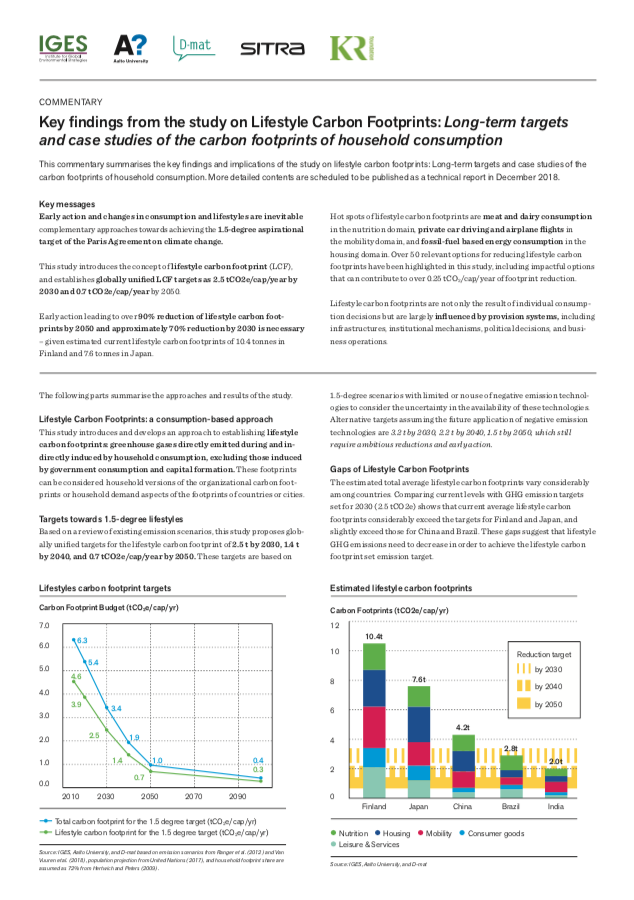
This commentary summarises the key findings and implications of the study on Lifestyle Carbon Footprints: Long-term targets and case studies of the carbon footprints of household consumption. This study introduces and develops an approach to establishing lifestyle carbon footprints: greenhouse gases directly emitted during and indirectly induced by...
Peer-reviewed Article
In 21st Conference of International Input-Output Association
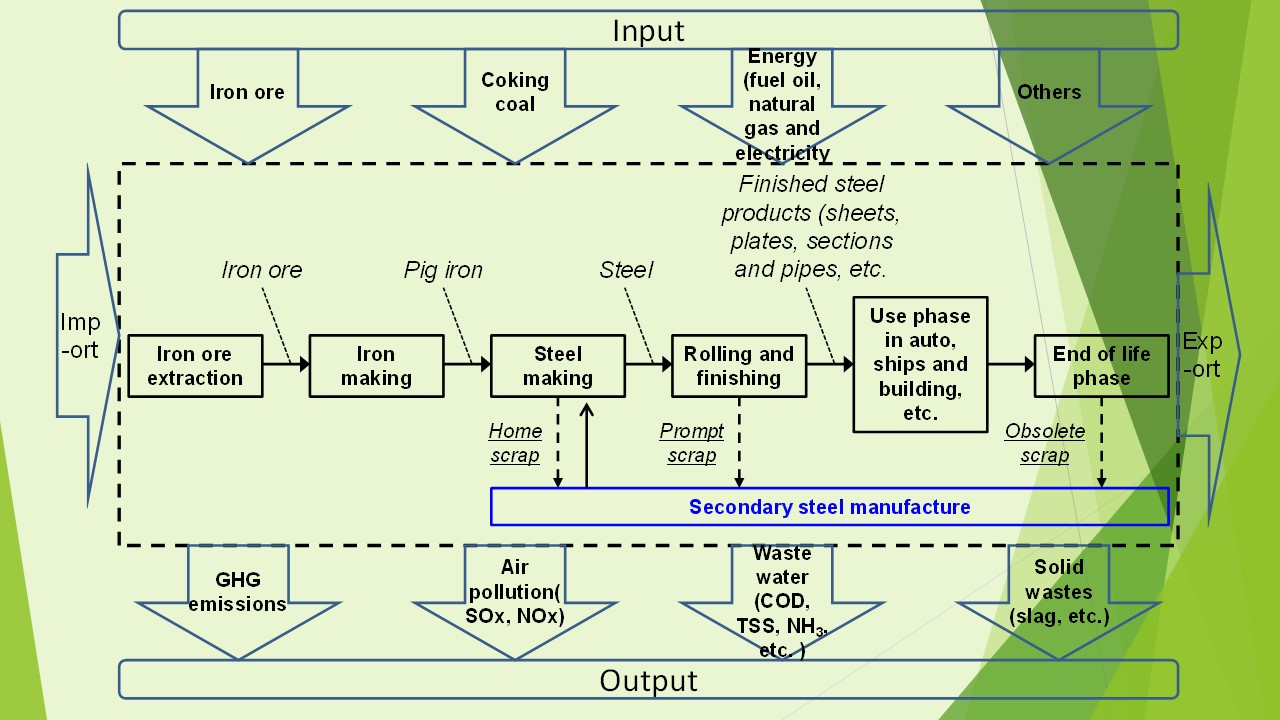
From 1971 to 2010, world trade grew fast by 10% per year on average (World Trade Organization 2011). The rapid growth of international trade contributes not only national economic growth but also increasing environmental pressures, such as raw material extraction and depletion, carbon emissions, water resource deterioration and landscape change and...