Results 1 - 10 of 18 (Sorted by date)
Peer-reviewed Article
In BioScience
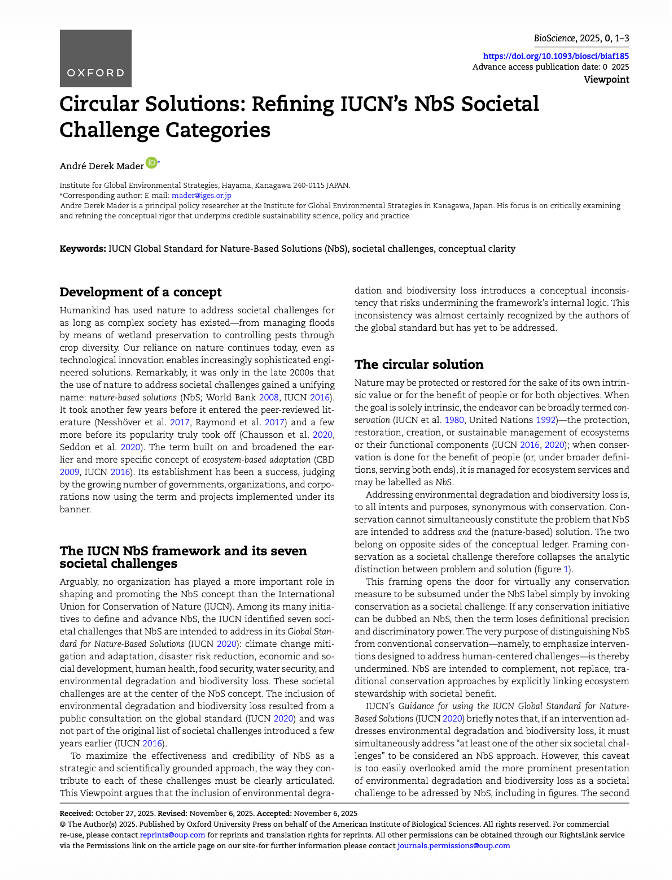
Extract (first section): Humankind has used nature to address societal challenges for as long as complex society has existed—from managing floods by means of wetland preservation to controlling pests through crop diversity. Our reliance on nature continues today, even as technological innovation enables increasingly sophisticated engineered...
Report Chapter
In Global Environment Outlook 7
Author:
Jacob Park
Susana Beatriz Adamo
Quosay Awad Ahmed
Ricardo O. Barra
Jonathan Davies
Rozana Himaz
Jinlong Liu
David Lopez-Carr
Indu K Murthy
Evans Osabuohien
Adina Manuela Relicovschi
Chao Ren
Roopesh Kevin Sungkur
Thomas F. Thornton
Chiara Varazzani
Samanta Villegas
Le Yu
A growing economy, increasing population and changing lifestyles are driving the demand for goods and services, such as materials, energy, and food. However, the current systems for producing and consuming these resources are unsustainable. They are shaped by poor governance structures and policies, particularly in the areas of economics and...
Report Chapter
In Global Environment Outlook 7
Author:
Riya
Rahiman
Aliyu
Aliyu
Farshad
Amiraslani
Elliot
Boateng
Lindsay
Beevers
Erica
Gaddis
Maryna
Henrysson
Saleemul
Huk
Andrei
Kirilenko
Mahdi
Kolahi
Jyotsna
Krishnakumar
Govind
Kelkar
Tao
Lin
Maria Cristina
Tirado
Nomanesi
Madikizela-Madiya
Valerie
Nelson
Jaee
Nikam
Kamaljit
Sangha
Sandya
Gunasekara
Savio Rousseau
Rozario
The global environmental crises – climate change, biodiversity loss, land degradation and desertification, and pollution and waste – are damaging human well-being and hindering progress of the economic and social dimensions of all the SDGs. Addressing these crises is a prerequisite for achieving the SDGs. Therefore, environmental goals and targets...
Conference Proceeding
15th International Conference on Sustainable Waste Management - Circular Economy (IconSWM-CE) and IPLA Global Forum 2025
In South Asia, a region facing rapid economic growth, immense population pressure, and high climate vulnerability, the circular economy (CE) has become a critical imperative for sustainable development. This study provides a comparative overview of the CE landscape across eight South Asian countries: Afghanistan, Bangladesh, Bhutan, India, Maldives...
Policy Report
The Paris Agreement Article 6 Implementation Status Report offers a snapshot of global progress in implementing Article 6 of the Paris Agreement. Compiled by the A6IP Center, the report examines the readiness of 100 countries to participate in international carbon markets; analyzes global carbon-market activities; and identifies current status...
Peer-reviewed Article
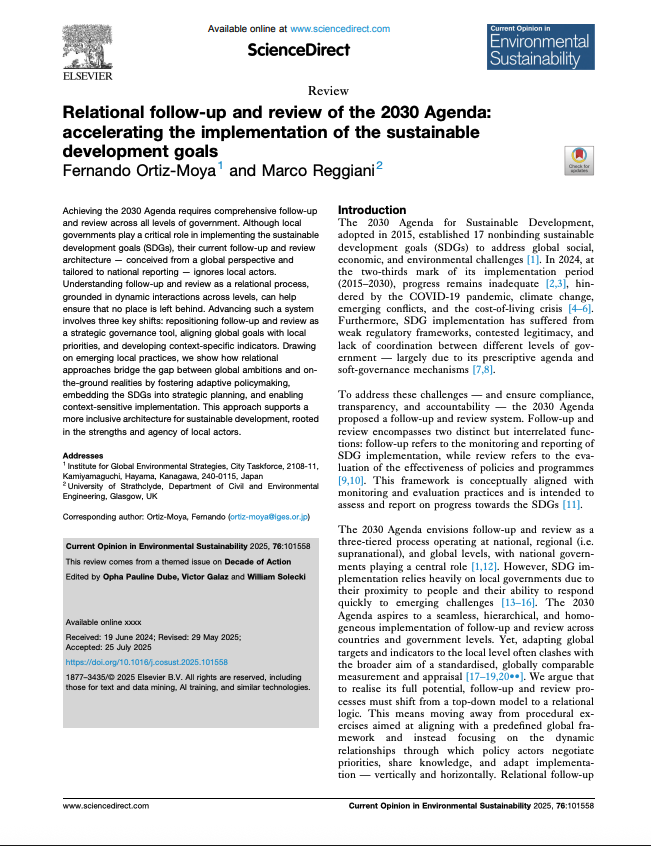
In Current Opinion in Environmental Sustainability
Author:
Marco
Reggiani
Achieving the 2030 Agenda requires comprehensive follow-up and review across all levels of government. Although local governments play a critical role in implementing the sustainable development goals (SDGs), their current follow-up and review architecture — conceived from a global perspective and tailored to national reporting — ignores local...
Presentation
ADBI The Model Forest Act Initiative (MoFAI) Japan Roundtable and Consultations
Through the lense of sustainable timber trade which I have forcused as a research topic, I proposed a possible solution to overcome the challenge in forest low implementation cost. In conclusion, when viewed through the lens of sustainable timber trade, a producer country's forest laws, the cost of strengthening forest law can be reframed. It is...
Policy Brief
Author:
Nidhi
Srivastava
Pía
Marchegiani
Sandeep
Pai
Critical energy transition minerals (CETMs) are vital for clean energy technologies, but their life cycle is associated with substantial environmental, social, and governance risks. These risks disproportionately affect local communities and countries in the Global South, where much of CETM extraction takes place. Despite bearing the burden of...
Presentation
2025 International Conference on Marine Environmental Management
The widespread issue of plastic pollution is increasingly affecting human health, with growing evidence of exposure, particularly in regions such as ASEAN, which are rich in aquatic resources. Microplastics and nanoplastics contaminate water bodies and are ingested by aquatic organisms. Given the high consumption of seafood in the region, humans...
Policy Report
Editor:
OECD
Southeast and East Asia play a pivotal role in global efforts to end plastic pollution. ASEAN Plus Three countries are at the heart of this region, represented by the 10 Member States of the Association of Southeast Asian Nations, Japan, Korea and the People’s Republic of China (hereafter, China). This region has become a hotspot for plastic...