- English


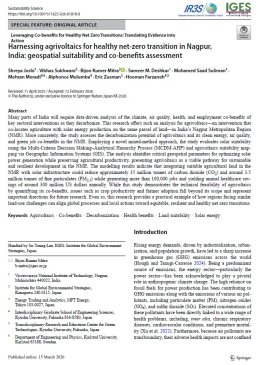
Many parts of India will require data-driven analysis of the climate, air quality, health, and employment co-benefits of key sectoral interventions as they decarbonize. This research offers such an analysis for agrivoltaics—an intervention that co-locates agriculture with solar energy production on the same parcel of land—in India’s Nagpur Metropolitan Region (NMR). More concretely, the study assesses the decarbonization potential of agrivoltaics and its clean energy, air quality, and green job co-benefits in the NMR. Employing a novel mixed-method approach, the study evaluates solar suitability using the Multi-Criteria Decision Making–Analytical Hierarchy Process (MCDM-AHP) and agrivoltaics suitability mapping via Geographic Information Systems (GIS). The analysis identifies critical geospatial parameters for optimizing solar power generation while preserving agricultural productivity, presenting agrivoltaics as a viable pathway for sustainable and resilient development in the NMR. The modelling results indicate that integrating suitable agricultural land in the NMR with solar infrastructure could reduce approximately 35 million tonnes of carbon dioxide (CO2) and around 3.5 million tonnes of fine particulates (PM2.5) while generating more than 100,000 jobs and yielding annual healthcare savings of around 300 million US dollars annually. While this study demonstrates the technical feasibility of agrivoltaics by quantifying its co-benefits, issues such as crop productivity and farmer adoption fall beyond its scope and represent important directions for future research. Even so, this research provides a practical example of how regions facing similar land-use challenges can align global processes and local actions toward equitable, resilient and healthy net zero transitions.
- English