
Results 5311 - 5320 of 5560 (Sorted by date)
Policy Report

Water shortages and water related problems in Asia are increasingly attracting concern. Ahead of the Third World Water Forum (WWF3), this issue of IRES, featuring on the sustainable management of freshwater resources, introduces issues and challenges in Asia and provides invaluable suggestions to future research. EDITOR'S NOTE http://enviroscope...
Policy Report
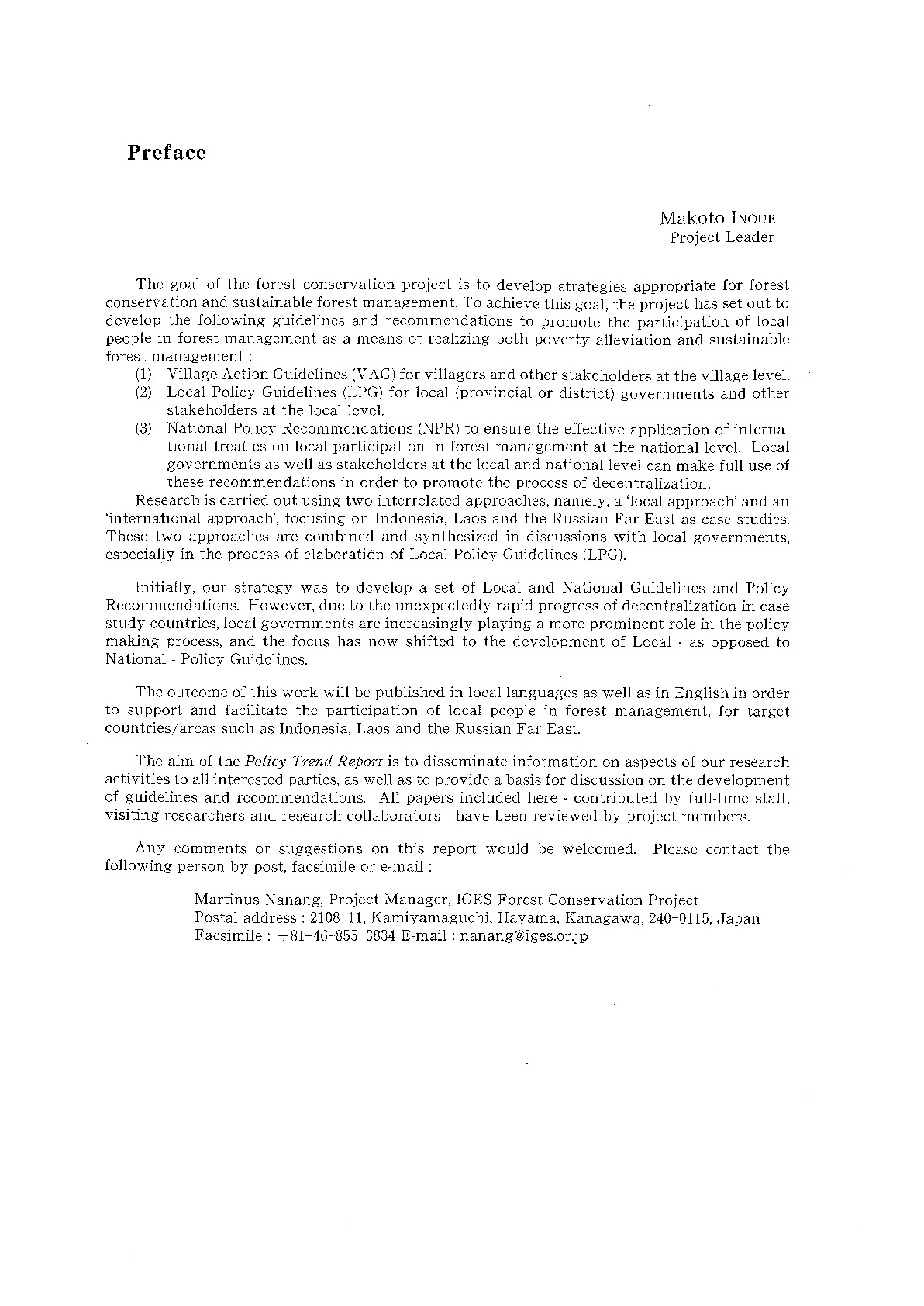
[Table of Contents] - Preface - Trends in China's forest-related policies - from the perspective of the growing timber trade / Masanobu YAMANE and Wenming LU - Trends in Malaysian Forest Policy / Weng-Chuen WOON and Haron NORINI - Trends in Forest Policy of the Philippines / Juan M. PULHIN - Farm Tree Planting and the Wood Industry in Indonesia : a...
Peer-reviewed Article

In International Review for Environmental Strategies (IRES) Volume3 Number2 (Winter 2002)
Water is vital for the life and health of people and ecosystems and a basic requirement for the development of countries, but many people lack access to adequate and safe water to meet their most basic needs. Water resources and their related ecosystems are now under threat from pollution, unsustainable use, climate change and many other forces...
Peer-reviewed Article
In International Review for Environmental Strategies (IRES) Volume3 Number2 (Winter 2002)
This paper presents the issues and concerns of the water sector in Asia and the Pacific, as well as the actions of the Asian Development Bank (ADB), to address existing problems and ensure the sustainability of water resources in the region. These water issues may be classified into institutional, resources management, and service delivery issues...
Peer-reviewed Article
In International Review for Environmental Strategies (IRES) Volume3 Number2 (Winter 2002)
The farmers of the Asian monsoon region have traditionally practiced forms of rice cultivation uniquely adapted to the climate of the region, which is characterized by annual precipitation far in excess of the global average of 800 mm and clearly delineated wet and dry seasons. In this region, water is used dynamically as part of a larger cycle...
Peer-reviewed Article
In International Review for Environmental Strategies (IRES) Volume3 Number2 (Winter 2002)
In developing countries, the major meaning of "sanitation" is the management of human excreta. In developing countries with poor water supply and sanitation systems, life expectancy is far lower than in industrialized countries. The causes of deaths are also quite different; infectious diseases account for more than 40 percent of deaths in...
Peer-reviewed Article
In International Review for Environmental Strategies (IRES) Volume3 Number2 (Winter 2002)
Basin countries of the lower Mekong River established the Mekong River Commission in 1995, replacing the former Mekong Committee created in 1957. At a glance, the role of the former resembles the latter, while the political and societal situation nowadays has provided quite a different set of mandates. In this paper, the changes observed and the...
Peer-reviewed Article
In International Review for Environmental Strategies (IRES) Volume3 Number2 (Winter 2002)
The Yellow River basin in China is harshly confronted by frequent water shortages and serious water pollution, along with the associated problems of intensifying floods and the deterioration of the ecology and environment. Water-related problems have become significant obstacles to sustainable development in the region, which points to the...
Peer-reviewed Article
In International Review for Environmental Strategies (IRES) Volume3 Number2 (Winter 2002)
Natural climate variability has a direct and fundamental bearing on water resources and their management, which are also likely to be strongly impacted by long-term climate change. This paper provides an overview of the relationship between climate variability and change and the management of freshwater resources, including the impacts of climate...
Peer-reviewed Article
In International Review for Environmental Strategies (IRES) Volume3 Number2 (Winter 2002)
Cambodia's forests and fisheries provide an important source of domestic earnings, essential to meeting the needs of rural people in Cambodia. In recent years, however, unregulated logging, slash-and-burn farming, and the demands of a growing population are posing serious threats to those resources. Community forest and fisheries resource...