
Results 3501 - 3510 of 5565 (Sorted by date)
Presentation
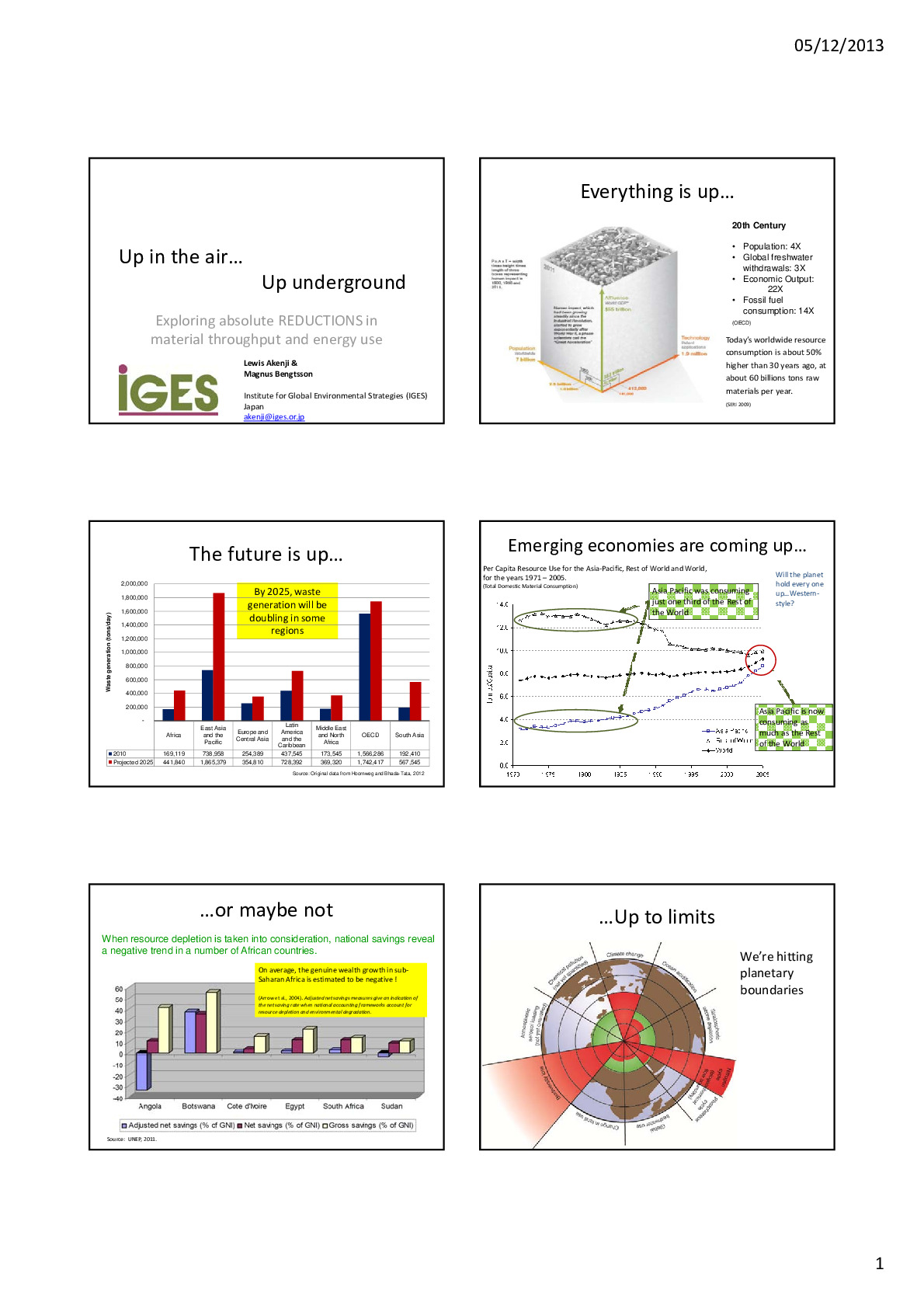
World Resources Forum 2013
Background presentation on REDUCTIONS: "Reducing Environmental Degradation & Unsustainable Consumption Trends & Impacts On Nature & Society: Research, Policy and Practice"
Non Peer-reviewed Article

In SAMEEEKSHA
Contributor:
Peer-reviewed Article
In Sustainability 2013
Data or Tool

This simulation provides a simple spreadsheet model for calculating greenhouse gas (GHG) emission from all the existing waste management practices (transportation, mix waste landfilling,composting, anaerobic digestion, mechanical biological treatment, recycling, incineration and open burning) in developing Asia. In addition, this simulation is...
Peer-reviewed Article

In Journal of Ecosystems
Contributor:
The paper provides an insight into the chronological extinction of the Indo-Malayan mangroves along the South and Southeast Asian coast and categorizes several area-specific anthropogenic and climatic factors that triggered the annihilation of 1.9 million ha of diverse mangroves. On a regional scale, coastal agricultural land development and shrimp...
Non Peer-reviewed Article
In SAMEEEKSHA
Contributor:
Presentation
Green Economy Training Program, Temple University
Commissioned Report
Due to a rapid increase in waste generation in Asia, recycling businesses are increasing their already significant contribution to sustainable solid waste management. At the same time, improper practices of recycling businesses can also generate serious health and environmental impacts. There is therefore a clear need to promote the scaling up of...
Presentation
International Conference on Sustainable Solution for Waste Management at Wuhan, China
Waste management is a critical issue in urban areas due to increases in its daily generation and the shortage of natural resources. The conventional approach of ‘collection and disposal’ is no longer acceptable in terms of sustainable socio-economic development and environmental conservation. Under these high pressures, an integrated approach that...
Presentation
Remarks: Presented at the 3rd Annual Conference Japanese Association for Human Security Studies, Keio University at Shonan-Fujisawa Campus, September 21 and September 22, 2013