- English
Date: 21-22nd Jan 2026, Tokyo, Japan
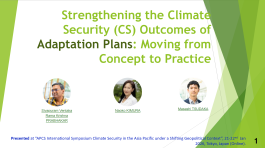


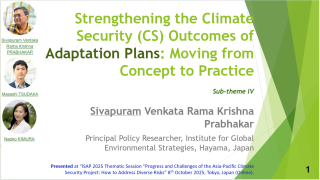
Climate change is increasingly recognized as a critical driver of human and national insecurity, yet its integration into climate adaptation planning remains limited. This study examines how climate security considerations can be systematically embedded within National Adaptation Plans (NAPs), moving from conceptual understanding to practical application. The research addresses three key questions: (i) what synergies and gaps exist between climate adaptation and climate security; (ii) how adaptation actions can contribute to human and national security outcomes; and (iii) how engagement with traditionally underrepresented stakeholders can strengthen climate security.
The study adopts a mixed-methods approach. First, a review of 67 NAPs submitted to the United Nations Framework Convention on Climate Change analyzes the extent to which security dimensions—such as food, energy, migration, and conflict—are reflected in national planning documents. The findings reveal a significant imbalance, with “adaptation” receiving far greater emphasis than “security,” indicating a limited explicit focus on climate security outcomes. Second, community-level participatory assessments in Sri Lanka and Fiji capture how climate change affects local perceptions of well-being and future aspirations. These exercises identify a measurable “security deficit,” reflected in declining confidence among communities in achieving personal and collective goals under climate stress. Third, stakeholder consultations with policymakers and practitioners highlight gaps in institutional coordination and differing interpretations of climate security across sectors.
The results demonstrate that while NAPs contribute indirectly to security, they rarely address peace, stability, and human well-being as explicit outcomes. A key finding is the disconnect between national-level planning and local-level experiences of insecurity. The study argues that strengthening climate security outcomes requires an integrated approach that bridges adaptation, human security, and national security perspectives. It further emphasizes the need to expand stakeholder engagement to include actors from the security, governance, and development domains. By proposing pathways to operationalize climate security within adaptation planning, this research contributes to advancing more holistic and effective policy frameworks in the Asia-Pacific region and beyond.
- English
Date: 21-22nd Jan 2026, Tokyo, Japan