- English


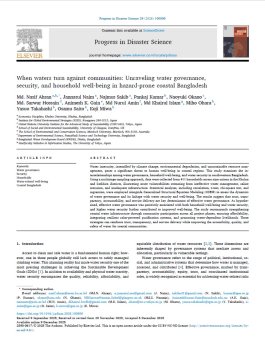
Water insecurity, intensified by climate change, environmental degradation, and unsustainable resource management,
poses a significant threat to human well-being in coastal regions. This study examines the interrelationships
among water governance, household well-being, and water security in southwestern Bangladesh.
Using a multistage sampling approach, data were collected from 411 households across nine unions in the Khulna
and Satkhira districts, illustrating acute vulnerabilities stemming from ineffective water management, saline
intrusion, and inadequate infrastructure. Statistical analyses, including correlation, z-test, chi-square test, and
regression, were employed alongside Generalized Structural Equation Modeling (GSEM) to assess the dynamics
of water governance and its linkage with water security and well-being. The results suggest that trust, transparency,
accountability, and service delivery are key determinants of effective water governance. As hypothesized,
effective water governance was positively associated with both household well-being and water security,
and higher water security further contributed to improved well-being. The study recommends strengthening
coastal water infrastructure through community participation across all project phases, ensuring affordability,
integrating resilient solar-powered purification systems, and promoting water-dependent livelihoods. These
strategies can reinforce trust, transparency, and service delivery while improving the accessibility, quality, and
safety of water for coastal communities.
- English