Approach to GST in the Southeast Asia Region
Approach to GST in the Southeast Asia Region

Latest from Southeast Asia
SB58 Side Event
Regional GST: Impacts, Challenges and Opportunities
iGST Southeast Asia Hub
At IGES, we aim to facilitate the GST process and utilise its opportunity to encourage a greater commitment to climate action worldwide. We recognise that the involvement of Non-State Actors (NSAs), such as civil society groups, businesses, local governments, academia, and NGOs, is crucial to the success of the GST process, which has a strong feature of collectiveness. By bringing in the perspectives, experience and technical knowledge of NSAs, we can fill gaps in the information assessed by the GST and improve the acceptability and effectiveness of its results in supporting countries' climate action and achieving their Nationally Determined Contributions (NDCs).
However, participation and engagement of NSAs in the GST have been a challenge for a variety of reasons. For example, the GST is not yet well known by NSAs as part of the process under the Paris Agreement, and international discussions in the GST are highly technical and complex to understand fully. There is also a lack of resources to engage with the GST, and it is still unclear what the incentives and benefits are of NSAs engagement with the GST. NSAs in Southeast Asia, in particular, have been left behind in the process.
Against this background, the independent Global Stocktake (iGST) Southeast Asia Hub (SEA Hub) aims to provide a platform to make NSAs’ voices and activities in Southeast Asia more visible in the GST process. This is a joint effort led by IGES and the Institute for Climate and Sustainable Cities (ICSC) with support from the ClimateWorks Foundation. The ClimateWorks Foundation runs iGST, which is a consortium of civil society actors working together to support the GST.
iGST SEA Hub represents a significant opportunity to promote greater awareness of the urgent need to address climate change in the region. By encouraging the participation of NSAs and bringing their knowledge and expertise to the GST process, we can drive progress towards a more sustainable future in Southeast Asia and beyond.
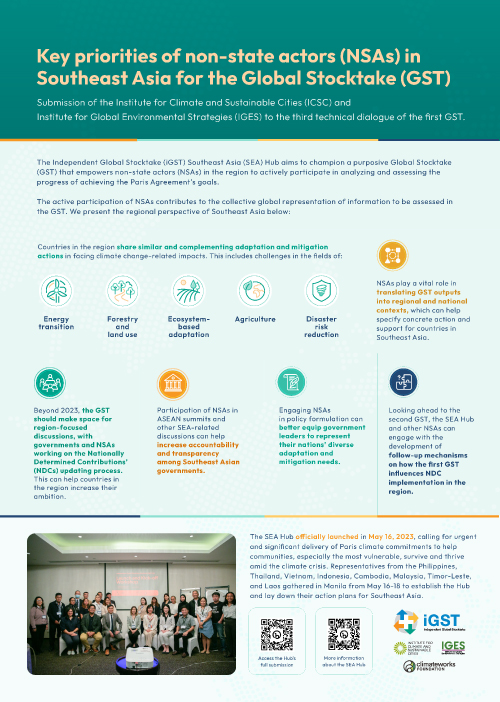
Key priorities of non-state actors (NSAs) in Southeast Asia for the Global Stocktake (GST)
Submission of IGES and the Institute for Climate and Sustainable Cities (ICSC) to the third technical dialogue of the first Global Stocktake
Perspectives
Climate-change review must involve vulnerable Asian communities
COP27 can accelerate equitable participation in discussion of impacts

Publications