|
| NEWS |
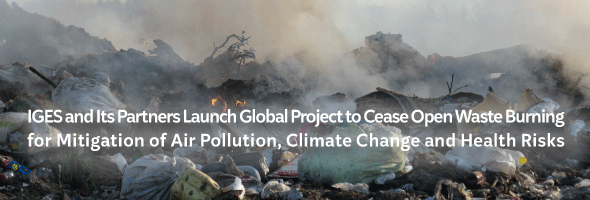
IGES and Its Partners Launch Global Project to Cease Open Waste Burning for Mitigation of Air Pollution, Climate Change and Health Risks
IGES, in partnership with Engineering X, the International Solid Waste Association (ISWA), Practical Action and UN Habitat, announced the launch of a ground-breaking project
"Creating the enabling conditions for eliminating open burning of waste through regional roadmaps and city pilots" supported by the United Nations Environment Programme’s Climate and Clean Air Coalition (CCAC).
The project, starting in March 2024 and spanning two years, is designed to confront and eliminate the environmentally detrimental practice of open waste burning, and underscores the critical strides being made towards the global ambition of mitigating air pollution and climate change impacts, aligned with the Paris Agreement, while also promoting economic development and health improvements.
 More details available here More details available here |
|
Establishment of Global Environmental Action (GEA) Secretariat
On 1 April 2024, IGES established the Global Environmental Action (GEA) Secretariat at the IGES Tokyo Sustainability Forum.
GEA is an NGO founded in 1991 by former Prime Minister Noboru Takeshita to contribute to the solution of global environmental problems and sustainable development.
For more than 30 years since then, GEA regularly organises international conferences together with influential key standings from government, business, academia and other fields of public opinion.
More details available here |
|
| PAST EVENTS |
Practical Workshop on Climate Assemblies: Featuring Local Cases in Japan and the UK (14 March)
Climate Citizens' Assemblies are anticipated to be one way for various regions and countries to have a broad social consensus on promoting the transition to a decarbonised society.
Climate Citizens' Assemblies gather together randomly selected citizens to form a microcosm of society. Assembly members are given balanced information with which to deliberate and formulate policy recommendations.
These assemblies have been spreading rapidly in European countries and municipalities since 2019, and have recently been held in Japan, mainly in the Tokyo metropolitan area, after being implemented in Sapporo in 2020.
This workshop invited Professor Stephen Elstub (Newcastle University, UK), who has been deeply involved in organising national and local Climate Citizens' Assemblies as a leading expert in the UK. The workshop brought together stakeholders involved in the practice and research of Climate Citizens' Assemblies in Japan to share and discuss their experiences.
In particular, several representative examples from Japan and the UK were highlighted, and case studies were conducted with participants on a wide range of aspects for the effective organisation of Climate Citizens' Assemblies, with the aim of making more progress going forward.
More details available here |
|
Asia-Pacific Climate Security Project (APCS) International Workshop "Ensuring Food Security under Climate Crisis" (13 March)
Food security is influenced by a number of factors. The Sixth Assessment Report of the Intergovernmental Panel on Climate Change, Working Group II (IPCC AR6 WG2) highlights that climate change affects different aspects of the global food system, adding to other types of risks and threats to the food system. Furthermore, responses to climate change also affect the food system.
This workshop was dedicated to mapping the field,and identifying research gaps and promising avenues so that we can ask the right questions to investigate this issue in the coming years.
More details available here |
|
The 5th Kitakyushu SDGs Training: Learn how renewable energy industries are revitalising economy and society in the City of Kitakyushu, Japan (5-7 March)
The 5th Kitakyushu SDG Training was held by the IGES Kitakyushu Urban Centre from 5 to 7 March for undergraduate and graduate students with diverse nationalities who were selected as participants via open application. This three-day programme visited renewable industry facilities and companies in Kitakyushu, including a hydrogen model house and the manufacturing site of offshore wind foundations.
The participants learned the potential and challenges of local energy self-sufficiency and consumption from a diverse range of stakeholders, including local governments, companies, organisations and NPO.
More details available here |
|
UNEA6 Side Event "Synergistic Approaches to Overcome the Triple Crisis and the SDG Deadlock" (1 March)
This side event, held at the 6th United Nations Environment Assembly (UNEA6), focused on the critical need for enhancing synergistic approaches to address the triple planetary crisis of climate change, biodiversity loss and pollution.
These issues are inextricably interlinked and significantly hinder the achievement of global agendas such as the 2030 Agenda for Sustainable Development and its Sustainable Development Goals. Against this background, Japan proposed a resolution on promoting synergies, which was adopted at UNEA6. At the side event, discussions revolved around a resolution to enhance collaborative efforts to address the triple planetary crisis.
The focus was on the essential role of leadership in promoting global synergistic actions, with international organisations expressing support for these initiatives. Various countries shared their strategies, highlighting successes and obstacles in fostering synergies. Emphasis was placed on the importance of responsible resource management and the role of scientific research in augmenting collaborative responses to environmental challenges. The event underscored the collective need for cooperation and knowledge sharing to address global environmental issues effectively.
More details available here
|
|
| RECRUITMENT / INTERNSHIP |
Open until filled
Water Team within our Adaptation and Water Area (AW) Policy Researcher
|
Open until filled
Strategic Management Office, Knowledge and Communications (SMO-KC)
Programme Coordinator (Senior Staff or Associate Staff)
|
| More details available here |
|
|