

Principal Policy Researcher
Professional Experience:
> Obtained funding from/managed/participated in research projects funded by: Suishinhi, Kakehnhi, ADB, APN, APAN and IFAD
>Worked in the following positions: Senior Policy Researcher, IGES, Japan (2010 onwards), Policy Researcher, IGES, Japan (2007-2010), JSPS Postdoctoral Fellow, Kyoto University, Japan (2005-2007), Visiting scholar, National Drought Mitigation Center (NDMC) at University of Nebraska–Lincoln (March 2007), Drought Specialist and Program Associate-DRM, United Nations Development Program-GoI DRM Program, New Delhi, India (2004-2005), Research Fellow, Rice-Wheat Consortium for the Indo-Gangetic Plains of International Maize and Wheat Improvement Center (CIMMYT), New Delhi, India (2001-2003), Research Fellow, Indian Agricultural Research Institute, IARI, New Delhi, India (2001), Research Fellow, International Crops Research Institute for Semi-Arid Tropics (ICRISAT), Hyderabad, India (1996).
Research Topics & Areas of Expertise
Currently engaged in the following research areas:
Measuring effectiveness of adaptation actions, Adaptation decision making frameworks, Scaling up risk insurance, Loss and damage associated with climate change, Equity and fairness in community based adaptation, Adaptive policies, Training needs assessment for climate change adaptation and Displacement and migration.
Education
Education:
1. PhD from Indian Agricultural Research Institute (IARI), New Delhi, India, 2001
2. PGD in Planning and Management, University of Hyderabad, India, 2004
3. MS (Ag) from Andhra Pradesh Agricultural University, India, 1996
4. BSc (Ag) from Andhra Pradesh Agricultural University, India, 1994
Results 201 to 210 of 346 (Sorted by date)
Peer-reviewed Article
In Journal of Food, Agriculture & Environment
Agriculture is a major economic sector and a critical source of livelihood in many of the low and middle income countries in Asia and the Pacific region. However, this sector is subject to a very wide range of risks related to natural hazards, climate change and variability, pest and diseases. This study review literatures that focus on disaster...
Presentation

Keio University Seminar Course
This lecture along with a class exercise was designed to introduce the Seminar students to the intricacies involved in adaptation decision making at global and local scales and to come up with an architecture of solutions for a given scenario in the future. The session starts with a lecture followed by group discussion by students to derive an...
Presentation

NABARD Consultation Meeting
This presentation introduces the Vulnerability and Capacity Assessment Index (VCAI) developed for NABARD as a national implementation entity for implementing Adaptation Fund projects. The presentation takes the participants through the concept of vulnerability, literature related to related assessments and tools and distills necessary design...
Book Chapter
In Climate Change 2014: Impacts, Adaptation, and Vulnerability. Part B: Regional Aspects. Contribution of Working Group II to the Fifth Assessment Report of the Intergovernmental Panel on Climate Change
Warming trends and increasing temperature extremes have been observed across most of the Asian region over the past century (high confidence). {24.3} Water scarcity is expected to be a major challenge for most of the region as a result of increased water demand and lack of good management (medium confidence). {24.4.3} The impacts of climate change...
Working Paper
IGES Working Paper
Water and sanitation play an important role in the sustainable development and are central to all activities of human beings and for the health of the natural ecosystems. For the past several decades, water and sanitation, especially water sector, have been subjected to two kinds of pressures i.e. developmental pressure and climate change related...
Commissioned Report
Adaptation to climate change has emerged as an important developmental issue for all countries. The adaptation finances are on continuous rise, both from the global and national sources, and it is essential that the agencies engaged in planning and execution of adaptation projects and programs have a set of tools made available to them to help with...
Presentation

International Conference on Mountain People Adapting to Change. Solutions Beyond Boundaries Bridging Science, Policy, and Practice.
Dr SVRK Prabhakar, whose works have focused on climate change adaptation and disaster risk reduction, said people often forget insurance is a post disaster recovery tool because of the overwhelming focus on the relief activities. The panel highlighted the need to broaden the definition of insurance, looking beyond formal insurance to nontraditional...
Presentation

Asia-Pacific Climate Change Adaptation Forum 2014, 1-3 October 2014, Kuala Lumpur, Malaysia
Insurance thus far has not gained its deserving attention as an effective post-disaster recovery tool though the actual role of insurance is always after the disaster. Several bottlenecks that hinder the efficiency and efficacy of insurance for long-term recovery are discussed including improper insurance price signals, contract design aspects and...
Presentation

Asia-Pacific Climate Change Adaptation Forum 2014, 1-3 October 2014, Kuala Lumpur, Malaysia
Non-economic loss and damage have not been uniformly and sufficiently reported in various international and national disaster databases. There are challenges such as difficulty in estimating loss and damage and incorporating them in risk reduction decision making. The APN project aims to prioritize important non-economic loss and damage and...
Presentation

Asia-Pacific Climate Change Adaptation Forum 2014,
The entire coastal belt of Bangladesh was already suffering from salinisation, caused by development and worsened by climate change. It used to be a freshwater ecosystem three or four decades ago but we had a lot of development work in the upstream area, and freshwater was reduced or supply was stopped. Salinity went up - then came sea-level rise...
Results 1 to 4 of 4 (Sorted by date)
Project

Updated: March 2025
Environment Research and Technology Development Fund 1CN-2206 (FY2022-2024) - Research on the national long-term roadmap to synergise mitigation and adaptation towards a net zero and resilient ASEAN
Towards the establishment of a net-zero and resilient ASEAN Community as indicated by the ASEAN Climate Vision 2050, IGES is conducting a study on the formulation of a long-term roadmap to promote integrated transition of mitigation and adaptation in...
Project
Updated: July 2026
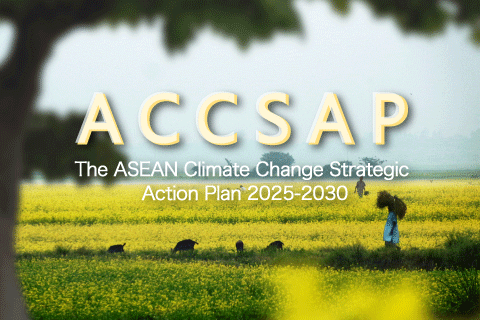
The ASEAN Climate Change Strategic Action Plan 2025-2030 Project
The ASEAN Climate Change Strategic Action Plan (ACCSAP) 2025-2030 serves as the roadmap for addressing climate change in ASEAN up to 2030. IGES contributed to the development of the “ASEAN State of Climate Change Report (ASCCR)” in 2021, the first...
Project
Updated: August 2026
Ensuring Security in Japan and the Indo-Pacific under Climate Change: A Focus on the Linkages with Economic Security
The climate security featured page will share research findings and related information on climate security. We are exploring various topics, including international trends analysis, energy security, food security, climate-induced human mobility, cl
Project
Updated: August 2023
IGES Inputs to Asia-Pacific Forum on Sustainable Development (APFSD)
APFSD is an annual meeting convened by the United Nations Economic and Social Commission for Asia and the Pacific (UNESCAP) aimed at strengthening the region’s readiness for the United Nations High-level Political Forum on Sustainable Development.