Search

Results 2041 - 2050 of 6422 (Sorted by date)
Policy Report
UNEP published the Air Pollution in Asia and the Pacific: Science-based Solutions, the first-ever comprehensive scientific assessment of air pollution outlook in the region. It outlines 25 clean air measures that could achieve safe air quality levels for 1 billion people by 2030 - with numerous benefits for public health, economic development and...
Policy Brief
T-20 Climate Change and Environment
Scientific evidence suggests that cumulative GHG emissions have already caused climate change, which tolled victims all over the world but quite often charged disproportionally high costs to poor segment of the world, and substantial mitigation actions are needed to avoid irreversible catastrophic change in ecosystems that underpin very human...
Peer-reviewed Article
In Small Carnivore Conservation
Author:
Hidemi
Nagano
Keiichi
Okada
Yoshihiro
Nakashima
Jamili
Nais
Kenehiro
Kitayama
Bornean Ferret Badger Melogale everetti is endemic to the uplands of the Mount Kinabalu and the Crocker Range, Sabah, north Borneo; it is currently categorized as Endangered on The IUCN Red List of Threatened Species. No systematic survey has been conducted and its ecology is largely unknown. To better understand the ecology of Bornean Ferret...
Policy Report
Asia is home to 60% of the world’s total population, with further population growth forecast in the future. In addition, the region accounts for 30% of global GDP and by 2050 this share is expected to exceed 50%, making Asia the region with the most dynamic growth in the world. Against this background, there is a worsening impact on the environment...
PR, Newsletter or Other
The Satoyama Development Mechanism (SDM) was established in 2013 to promote activities in line with the Strategy and Plan of Action of the International Partnership for Satoyama Initiative (IPSI) through the provision of seed funding to promising projects proposed by IPSI members. Six projects have been selected every year, bringing the total...
Report Chapter
Author:
Haripriya
Gundimeda
Shizuka
Hshimoto
Phillip
Riordan
Shunsuke
Managi
Jonathon
Anticamara
Sonali
Ghosh
Sunieeta
Subramanian
Ruchi
Badola
The chapter focuses on future scenarios of Biodiversity and Ecosystem nServices (BES) and implications to human well-being in the Asia-Pacific region and account for the unique regional characteristics and national policy making practices related to conservation of BES.
Book
Author:
Masago
Yoshifumi
Binaya Kumar
Mishra
Shokhrukh-Mirzo
Jalilov
Mohamed
Kefi
Misato
Dilley
Kensuke
Fukushi
Worldwide, scarce freshwater resources are increasingly being used to satisfy the demands of a rapidly increasing population and a growing global economy. One-third of the world’s river basins have reached their capacity for exploitation, and half of the global population is directly affected by water scarcity. Furthermore, the increasing rate of...
Briefing Note
Author:
Tsutomu
Ichikawa
Karen G.
Villholth
Payments for ecosystem services (PES) is a market-based mechanism aimed at sustaining the flow of such services. Through a PES scheme, beneficiaries or users of the ecosystem service(s) compensate the provider or manager of those services, directly or indirectly. The provider and beneficiaries agree on the terms and conditions of the PES and...
Submission to Policy Process
Contributing Papers for the 2019 Global Assessment Report
Author:
Karen G.
Villholth
Paul
Pavelic
Andrew
Ross
Groundwater is a de-facto source of water during drought and emergencies. In a broader perspective, the traditional short-term strategy of using groundwater to combat water deficits during drought needs revisiting. The objective of this paper is to examine the relevance and options for developing and adopting such groundwater-based natural...
Report Chapter
Editor:
United Nations Environment Programme (UNEP)
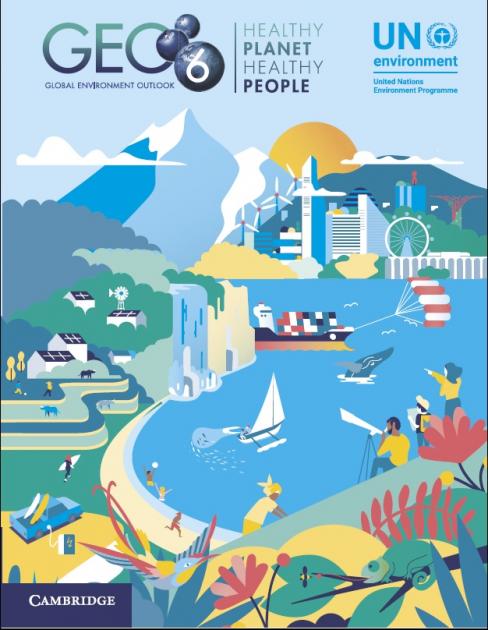
Under the theme of ‘Healthy Planet, Healthy People,’ the sixth Global Environment Outlook (GEO-6) is an integrated assessment which considers various scientific perspectives and inputs from across the world in a holistic manner. The assessment urges the world’s decision makers and all citizens to apply the principles of sustainable development to...