Results 51 - 60 of 512 (Sorted by date)
Conference Paper
Proceeding of The Eastern Asia Society for Transportation Studies
Author:
Russ Bona
Frazila
Febri
Zukhruf
Jongga
Jihanny
Kardina
Nawassa
The benefits of walking have recently inspired considerable research on the relationships between pedestrian choices and numerous built environment factors. These relationships are then elaborated using walkability indices for the meso- the micro-levels. Despite important advances in micro-level research, the walkability concept is based chiefly on...
Discussion Paper
Author:
Bambang
Haryono
Mochamad
Farhan
Muhammad Luthfi Eko
Nugroho
Maryono
Satria
Utama
Hadiyanto
Tomoki
Ehara
Kazuya
Fujiwara
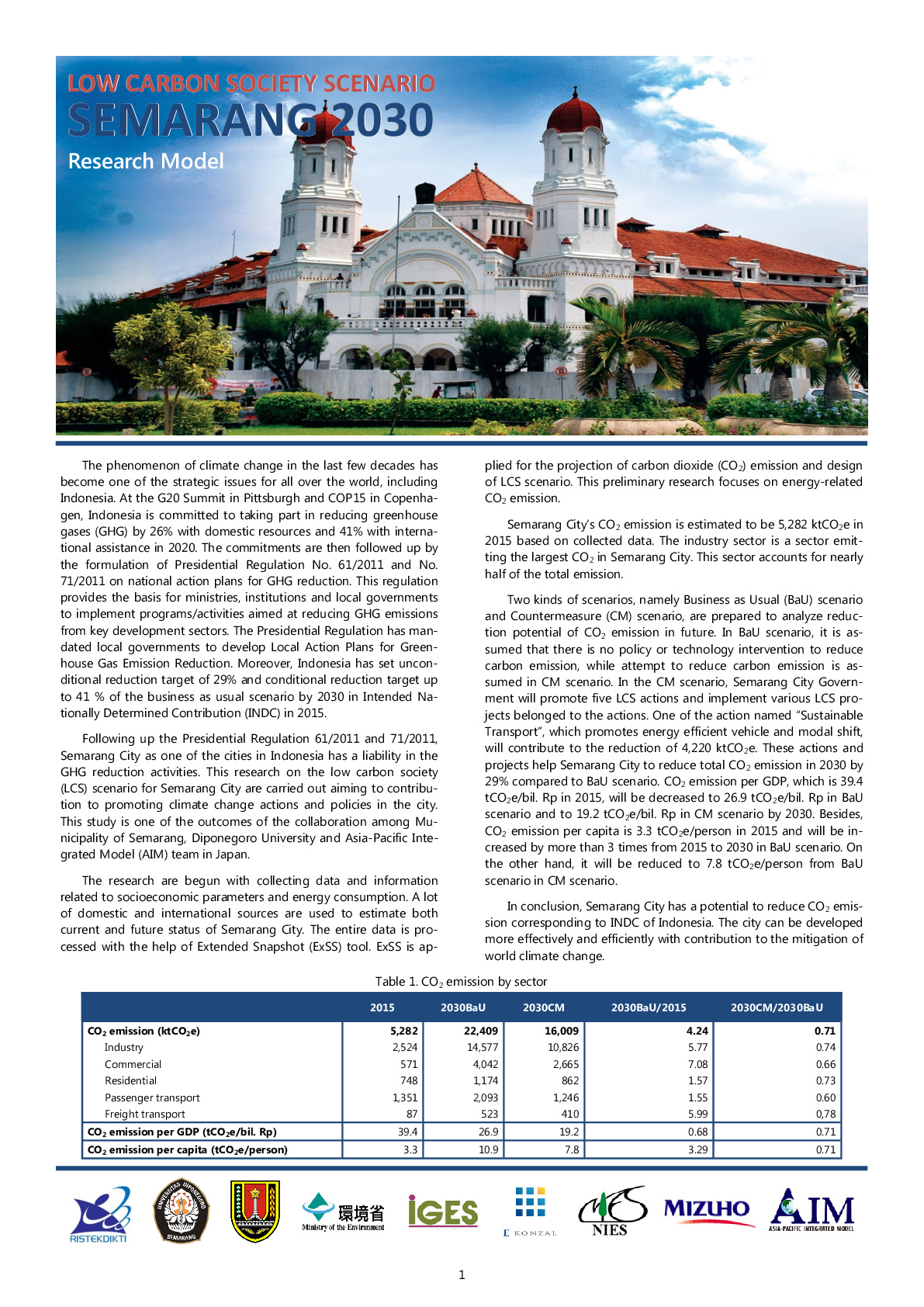
Following up the Presidential Regulation 61/2011 and 71/2011, Semarang City as one of the cities in Indonesia has a liability in the GHG reduction activities. This research on the low carbon society (LCS) scenario for Semarang City are carried out aiming to contribu-tion to promoting climate change actions and policies in the city. This study is...
Conference Proceeding
Training of trainers workshop on ‘dissemination of Japanese low carbon technologies in India’ was organised on September 27, 2017, at Hotel Crowne Plaza, Pune by TERI in collaboration with Maharashtra Energy Development Agency (MEDA). The event was supported by ‘Institute for Global Environmental Strategies’ (IGES), Japan. This proceeding contains...
Technical Report
Author:
Takayuki
URASHI
Natee
KATEMANOROM
This report is related to the feasibility study on the potential application of Japanese low carbon technologies, namely once-through boiler was conducted on October 30, 2017 at Carabao Tawandang CO.,LTD. at Samutprakarn in Thailand. It was a part of the activities conducted in Thailand in FY2017 under the “Technology Assessment” project, which is...
Peer-reviewed Article
In Global Environmental Research
Author:
Minoru
Morita
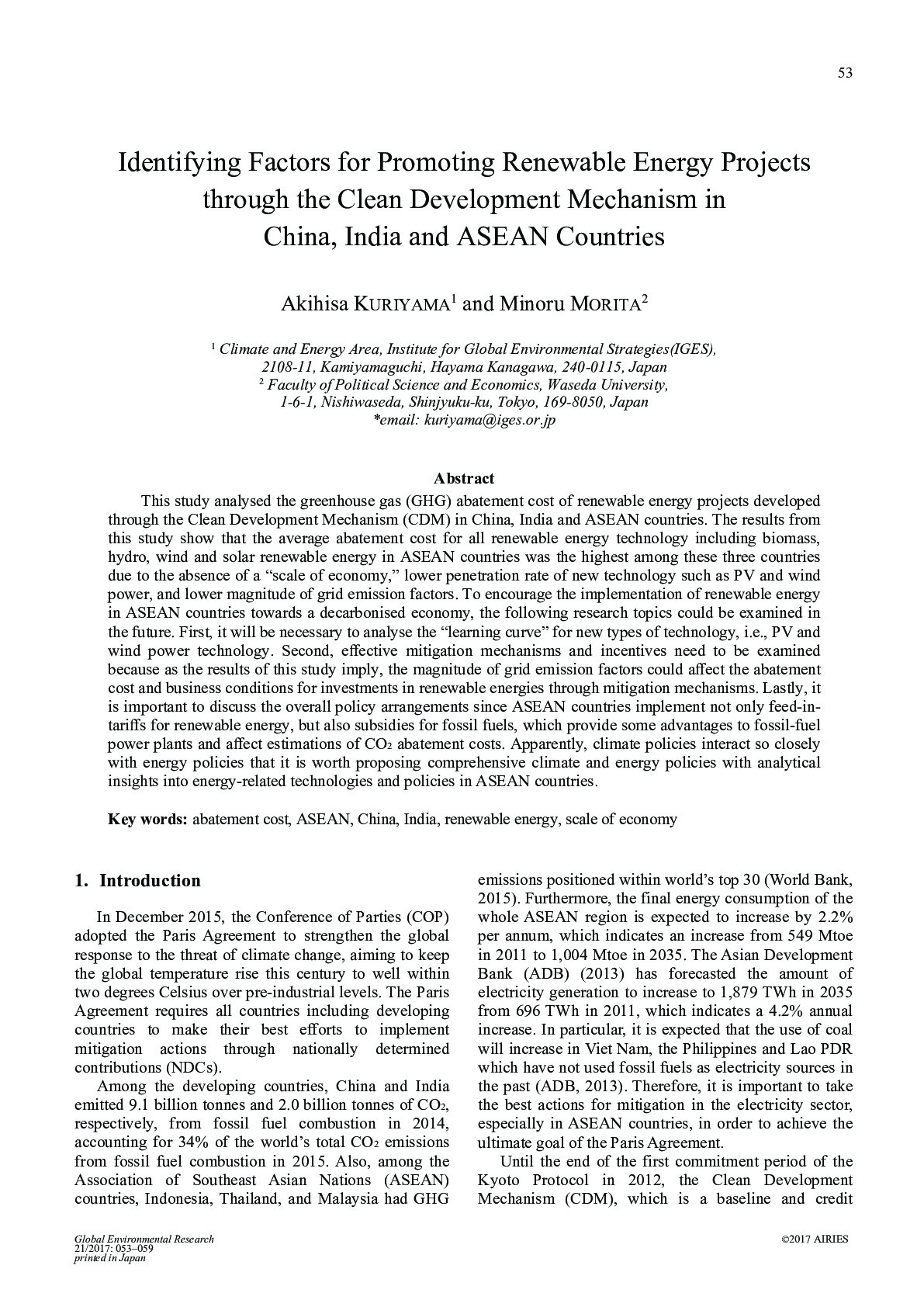
This study analysed the greenhouse gas (GHG) abatement cost of renewable energy projects developed through the Clean Development Mechanism (CDM) in China, India and ASEAN countries. The results from this study show that the average abatement cost for all renewable energy technology including biomass, hydro, wind and solar renewable energy in ASEAN...
Presentation
Carbon dioxide (CO2), which is considered as a primary driver of climate change, is responsible for slightly more than half of the total current warming impact from human-caused emissions (EESI, 2013). Emitted CO2 remain in the atmosphere for hundreds of years, creating warming effect even the new CO2 level reduce to zero. Therefore, the strategies...
Presentation
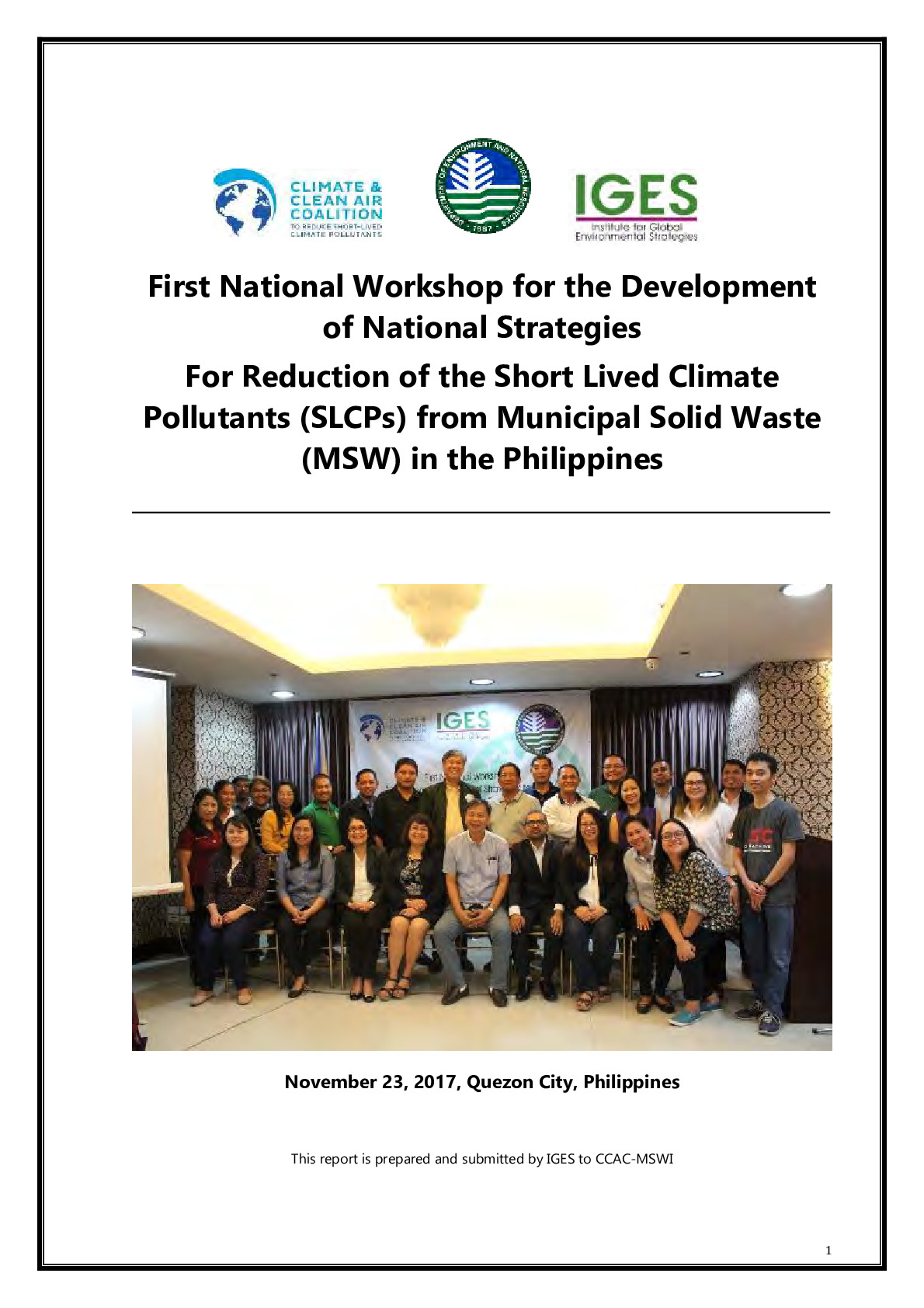
First National Workshop for Development of National Strategy for Reduction of Short-Lived Climate Pollutants (SLCPs) from Municipal Solid Waste (MSW) in the Philippines
Carbon dioxide (CO2), which is considered as a primary driver of climate change, is responsible for slightly more than half of the total current warming impact from human-caused emissions (EESI, 2013). Emitted CO2 remain in the atmosphere for hundreds of years, creating warming effect even the new CO2 level reduce to zero. Therefore, the strategies...
Conference Proceeding
Carbon dioxide (CO2), a primary driver of climate change, is responsible for more than half of the total current warming impact of human-caused emissions. Emitted CO2 remains in the atmosphere for hundreds of years, absorbing heat that contributes to a warming effect even after initial CO2 concentrations start falling. Taking this into...
Policy Report
Author:
UNESCAP
Heinz
Schandl
ASEAN is committed to the implementation of two parallel, but inter related processes: the ASEAN Community Vision 2025 (ASEAN Vision 2025) and the United Nations 2030 Agenda for Sustainable Development (2030 Agenda). From the outset ASEAN Member States underlined the complementarity of these two agendas in their efforts to uplift the standards of...
Training or Learning Material
Cities contribute more than 70% of global greenhouse gas emissions; therefore, low-carbon city development needs to be enhanced for achieving the “2 degree Celsius target” of the Paris Agreement and the Sustainable Development Goals (SDGs). Appropriate policies and measures at both national and local levels need to be implemented for mobilizing...