Results 1 - 9 of 9 (Sorted by date)
Peer-reviewed Article
In Sustainability
Author:
Kesar
Chand
Jagdish Chandra
Kuniyal
Shruti
Kanga
Raj Paul
Guleria
Gowhar
Meraj
Majid
Farooq
Suraj Kumar
Singh
Mahendra Singh
Nathawat
Netrananda
Sahu
Raj
Kumar
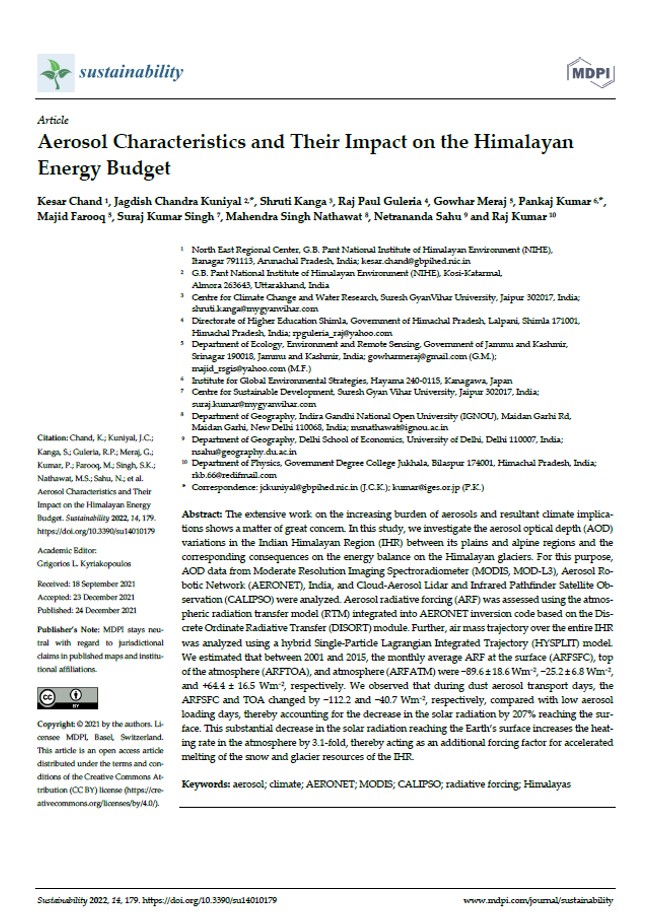
The extensive work on the increasing burden of aerosols and resultant climate implications shows a matter of great concern. In this study, we investigate the aerosol optical depth (AOD) variations in the Indian Himalayan Region (IHR) between its plains and alpine regions and the corresponding consequences on the energy balance on the Himalayan...
Peer-reviewed Article
In Remote Sensing
Author:
Sk
Mithun
Mehebub
Sehana
Subrata
Chattopadhyay
Khaled
Kheder
Ram
Avtar
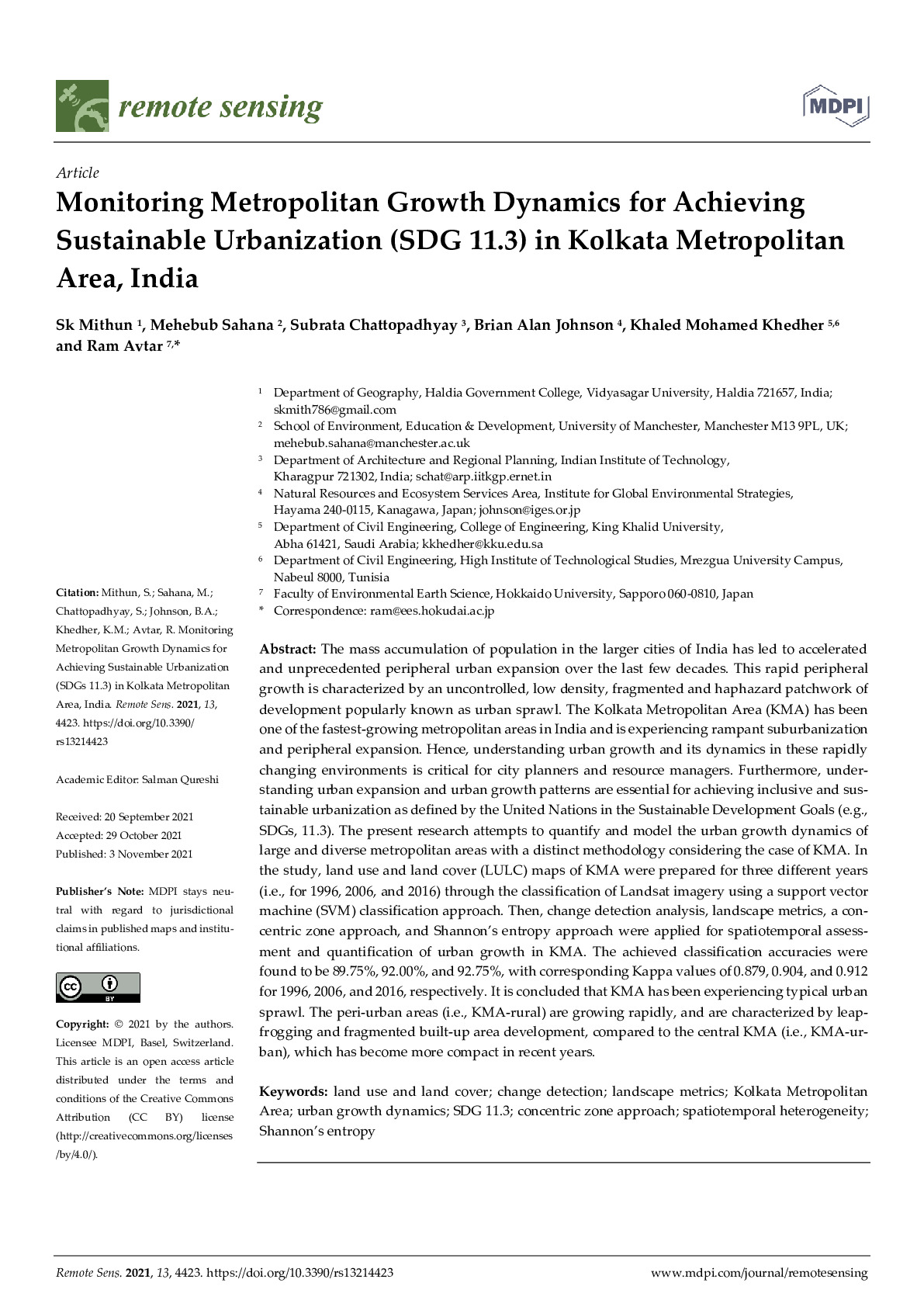
The mass accumulation of population in the larger cities of India has led to accelerated and unprecedented peripheral urban expansion over the last few decades. This rapid peripheral growth is characterized by an uncontrolled, low density, fragmented and haphazard patchwork of development popularly known as urban sprawl. The Kolkata Metropolitan...
Peer-reviewed Article
In Environmental Research Communications
Author:
Mrittika
BASU
Shalini
Dhyani
With the increasing spread of the Covid-19 pandemic, restrictions on public life were strengthened across the world. Non-pharmaceutical interventions like stay-at-home orders, cancellations of events, work from home, etc. are the first line of defense to combat the spread of highly transmittable infections like Covid-19. But these interventions...
Discussion Paper
Japanese companies have pioneered the development of a large number of low-carbon technologies (LCTs). As a rapidly expanding economy with burgeoning energy requirements, India offers a significant potential market for Japanese LCTs. The industry sector in India accounts for a significant share of commercial energy use and hence carbon dioxide (CO2...
Peer-reviewed Article
In Environmental Management
Author:
Shalini
Dhyani
MRITTIKA
BASU
Rakesh
Kadaverugu
Shizuka
Hashimoto
Ram
Avtar
Priyanka
Mitra
Globally, shifting cultivation is known to be an important driver of tropical deforestation. However, we argue that it can be sustainably managed if the environmental boundary conditions, laid by the traditional customs and practices, are fully respected. We narrate an empirical study from the Zunheboto district of Nagaland, India, where we...
Book Chapter
In Environmental Resilience and Transformation in Times of COVID-19
Author:
Ritika
Mandhyan
Atul
Rawat
Eri
Ikeda
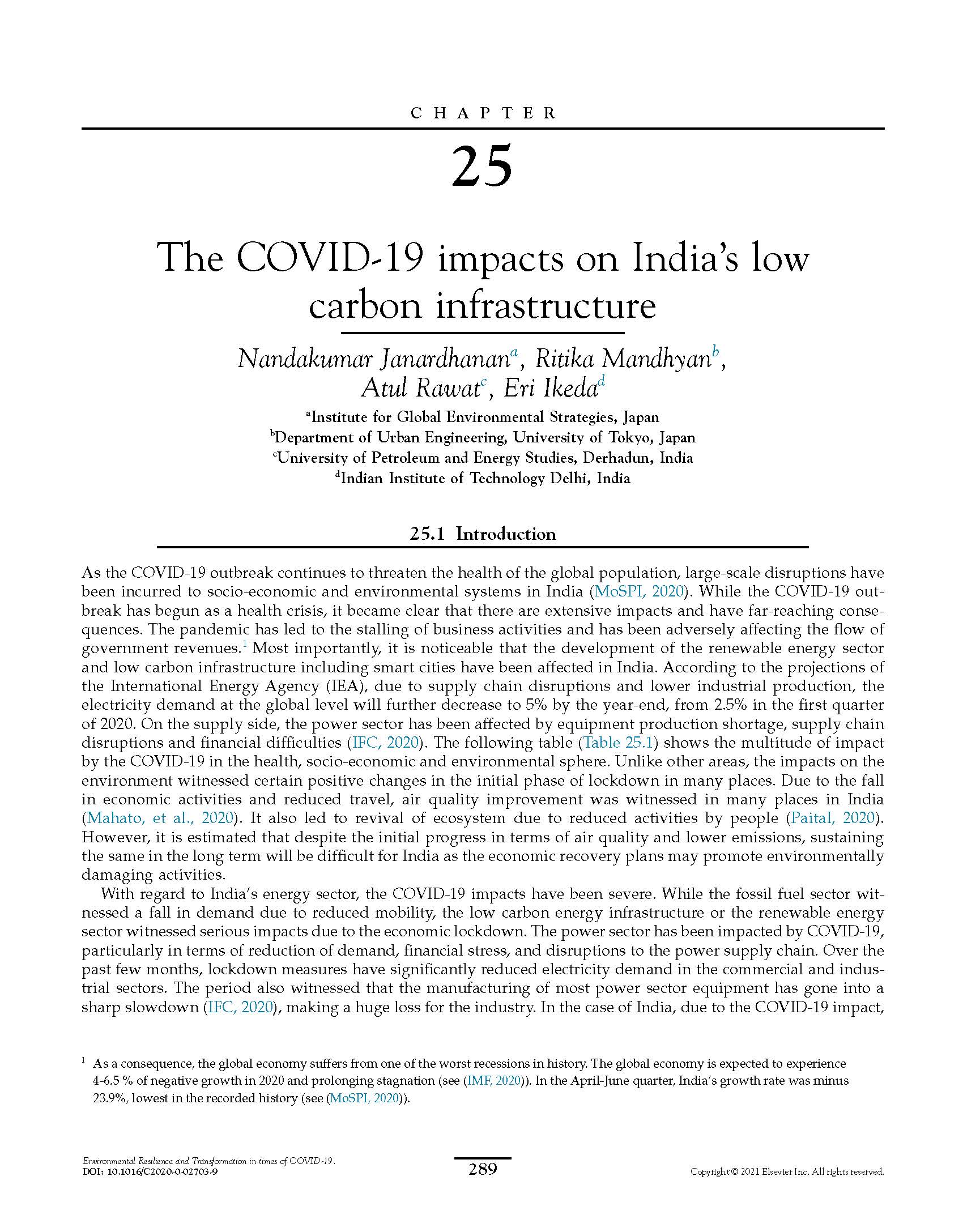
The COVID-19 pandemic has posed unprecedented challenges to the global economy. India faces a multitude of challenges due to COVID-19 impacts. The pandemic-induced economic lockdown has posed barriers to various clean energy and low carbon infrastructure development projects. The renewable energy sector, which has been heavily dependent on global...
Peer-reviewed Article
In Journal of Coastal Conservation
Author:
Rakesh
Kadaverugu
Shalini
Dhyani
Shizuka
Hashimoto
Paras
Pujari
Bhitarkanika National Park and Mahanadi Delta are the most biologically diverse mangrove patches of India. Due to inadequate representation of the value of the mangroves in decision-making, mangroves of Bhitarkanika and Mahanadi delta have undergone a rapid decline in the last fifty years. Thus, there is a growing need to assess the ecosystem...
Peer-reviewed Article
In Sustainability Science
Author:
Shizuka
Hashimoto
Mrittika
Basu
Shalini
Dhyani
The paper narrates an empirical study of participatory mapping and spatial characterization of six non-material landscape values across multiple coastal production landscapes in the Indian Sundarban delta. The methodology relies on an inexpensive rapid rural appraisal technique that integrates the conventional notion of place preference and...
Fact Sheet
Author:
Vimlendu Kumar
JHA
Ashim
BERY
Kuldip Singh
SANGWAN
Kailash
CHOUDHARY
This catalogue has been produced for the workshops and home experiments organised by the 1.5ºC Lifestyle Project. A decarbonised lifestyle to limit the carbon footprint (CFP), including CO₂ emissions plus CO₂ equivalent of the other greenhouse gas (GHG) emissions to 2,500 kg per year in 2030 and 700 kg per year in 2050. The options are divided into...