

Principal Policy Researcher
Professional Experience:
> Obtained funding from/managed/participated in research projects funded by: Suishinhi, Kakehnhi, ADB, APN, APAN and IFAD
>Worked in the following positions: Senior Policy Researcher, IGES, Japan (2010 onwards), Policy Researcher, IGES, Japan (2007-2010), JSPS Postdoctoral Fellow, Kyoto University, Japan (2005-2007), Visiting scholar, National Drought Mitigation Center (NDMC) at University of Nebraska–Lincoln (March 2007), Drought Specialist and Program Associate-DRM, United Nations Development Program-GoI DRM Program, New Delhi, India (2004-2005), Research Fellow, Rice-Wheat Consortium for the Indo-Gangetic Plains of International Maize and Wheat Improvement Center (CIMMYT), New Delhi, India (2001-2003), Research Fellow, Indian Agricultural Research Institute, IARI, New Delhi, India (2001), Research Fellow, International Crops Research Institute for Semi-Arid Tropics (ICRISAT), Hyderabad, India (1996).
Research Topics & Areas of Expertise
Currently engaged in the following research areas:
Measuring effectiveness of adaptation actions, Adaptation decision making frameworks, Scaling up risk insurance, Loss and damage associated with climate change, Equity and fairness in community based adaptation, Adaptive policies, Training needs assessment for climate change adaptation and Displacement and migration.
Education
Education:
1. PhD from Indian Agricultural Research Institute (IARI), New Delhi, India, 2001
2. PGD in Planning and Management, University of Hyderabad, India, 2004
3. MS (Ag) from Andhra Pradesh Agricultural University, India, 1996
4. BSc (Ag) from Andhra Pradesh Agricultural University, India, 1994
Results 261 to 270 of 346 (Sorted by date)
Policy Report

Research Report
There is a growing consensus among development community that the risk insurance can provide an effective risk management tool for climatic and non-climatic disasters. Several risk insurance initiatives have been implemented at grassroots level for reducing the vulnerability of communities to disasters in most of the countries in Asia and the...
Policy Report

APAN-IGES Research Report
Pilot training programs were conducted in Cambodia for province and sub-province level government officers of the agriculture department to test the effectiveness of draft training modules on climate change adaptation. The pilot tested training modules include ‘Agriculture extension staffs at provincial level’ and ‘District and commune officers’...
Peer-reviewed Article
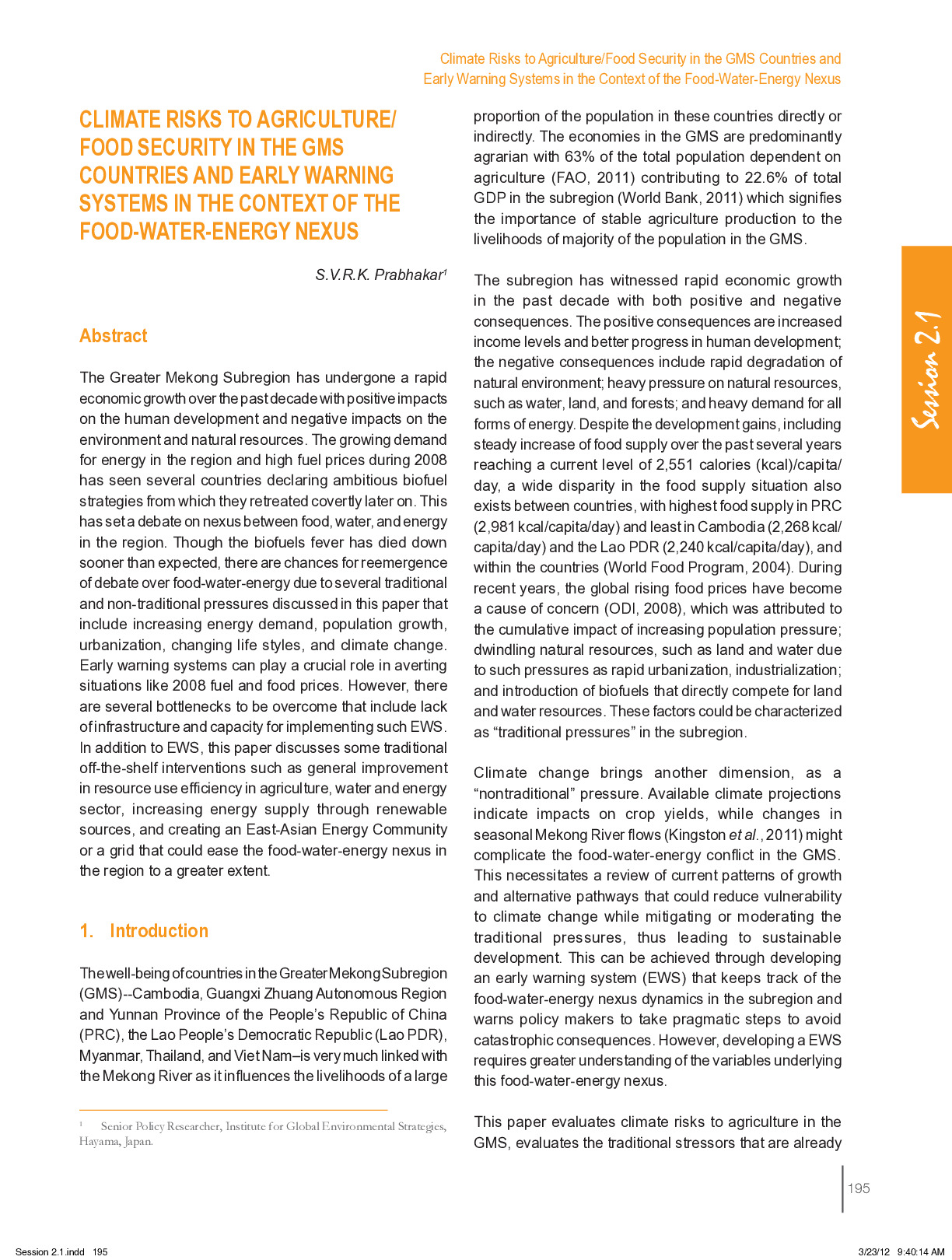
In International conference on GMS 2020: Balancing Economic Growth and Environmental Sustainability
The Greater Mekong Subregion has undergone a rapid economic growth over the past decade with positive impacts on the human development and negative impacts on the environment and natural resources. The growing demand for energy in the region and high fuel prices during 2008 has seen several countries declaring ambitious biofuel strategies from...
Presentation
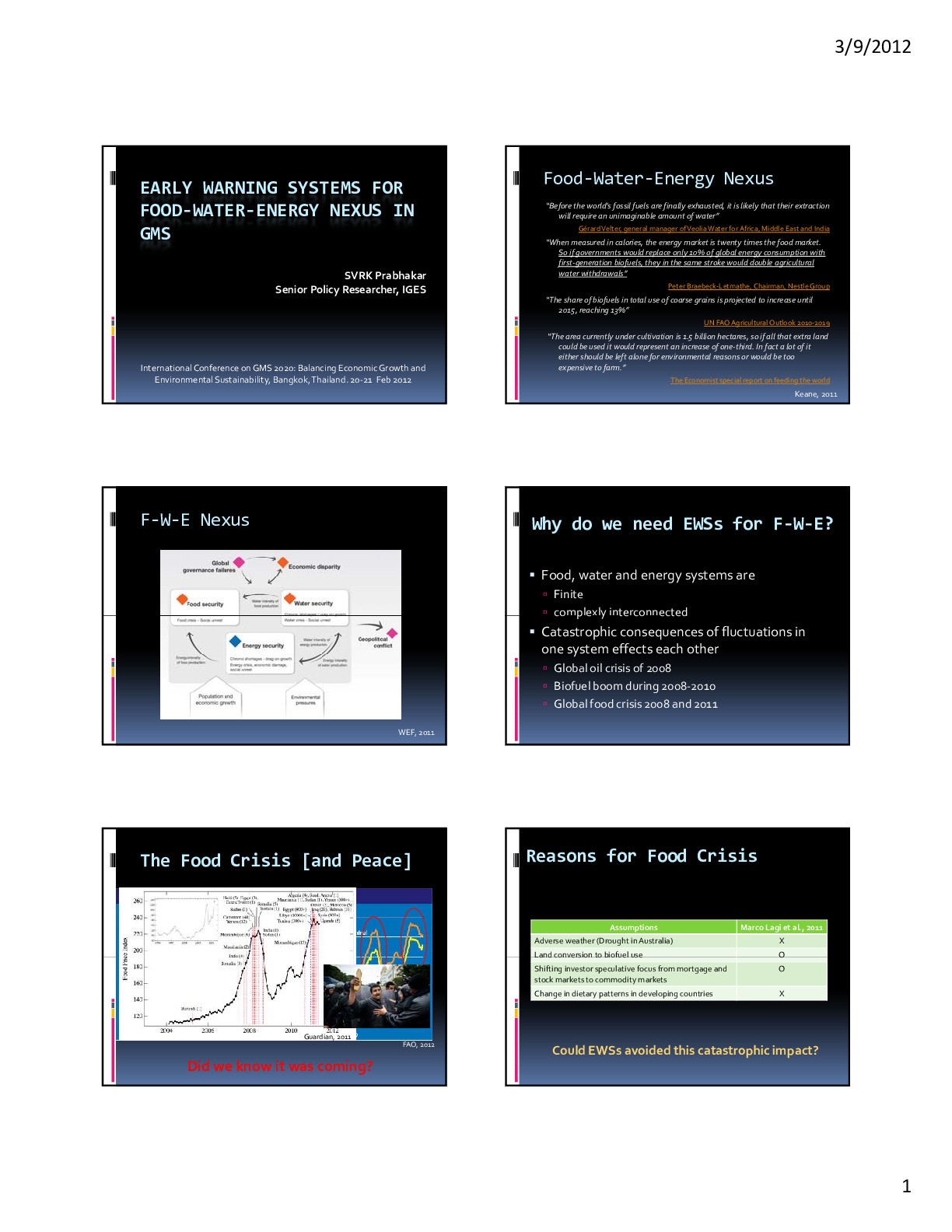
International Conference on GMS 2020: Balancing Economic Growth and Environmental Sustainability
Though a first step, this presentation provides a framework for developing an early warning system (EWS) linking food, water and energy systems. It lists the issues with the standalone EWS, clarifies the importance of representing the linkages between Food-Water-Energy systems, identifies determinants for an effective FWE-EWS, and discusses...
Presentation

Asia-Pacific Climate Change Adaptation Forum 2012
Organizer:
This session has addressed four important questions underlying the public participation and promoting fairness. They include: How adaptation decisions are made? Are the typical processes by which adaptation is governed fair? Is participation and representation of vulnerable groups sufficient? Are rights to adaptation being respected and access to...
Peer-reviewed Article

In Journal of Environmental Hazards
This paper reviews climate change impacts and existing disaster risk management system in Japan and offers results of a structured questionnaire survey of the community leaders and disaster risk management personnel of Saijo city of Japan that assesses their perceptions about dealing with the extreme disasters by the existing disaster risk...
Research Report

Research Report to the Asia Pacific Network for Global Change Research
The project entitled “Scientific Capacity Development of the Trainers and Policy Makers for Climate Change Adaptation Planning in Asia and the Pacific”, funded by the Asia Pacific Network for Global Change Research (APN) under the ‘CAPaBLE’ programme, was implemented as a part of Asia Pacific Adaptation Network (APAN) activities that aimed at...
Presentation
8th International Conference of NAPSIPAG 2011
It has been widely regarded that policies and institutions that are adaptive in nature are better able to deal with the dynamic issues such as environmental degradation and climate change adaptation. However, verifying the veracity of this hypothesis is difficult often due to absence of long experience in climate change adaptation in most countries...
Presentation
8th International Conference of NAPSIPAG 2011
The ongoing negotiations for the future climate regime have clearly indicated the need for both the developed and developing countries to work together in enhancing the adaptation to climate change. While much of the climate change adaptation debate has long been focused on the developing countries, little emphasis has been made on the need for...
Presentation
International Conference on Adaptation to Climate Change and Food Security in West Asia and North Africa
The West Asia and North African (WANA) countries are projected to undergo a range of climate change impacts that can put even greater pressure on the already over utilized water and land resources in the region calling for an urgent intervention for climate change risk reduction in these countries. Though WANA appears to be a rich region from the...
Results 1 to 4 of 4 (Sorted by date)
Project

Updated: March 2025
Environment Research and Technology Development Fund 1CN-2206 (FY2022-2024) - Research on the national long-term roadmap to synergise mitigation and adaptation towards a net zero and resilient ASEAN
Towards the establishment of a net-zero and resilient ASEAN Community as indicated by the ASEAN Climate Vision 2050, IGES is conducting a study on the formulation of a long-term roadmap to promote integrated transition of mitigation and adaptation in...
Project
Updated: July 2026
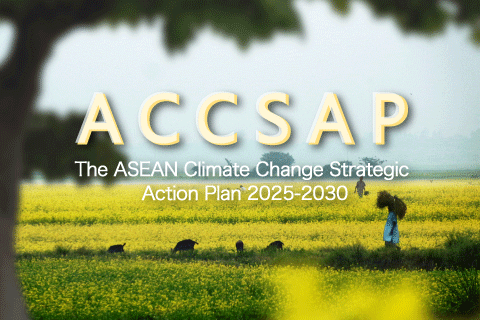
The ASEAN Climate Change Strategic Action Plan 2025-2030 Project
The ASEAN Climate Change Strategic Action Plan (ACCSAP) 2025-2030 serves as the roadmap for addressing climate change in ASEAN up to 2030. IGES contributed to the development of the “ASEAN State of Climate Change Report (ASCCR)” in 2021, the first...
Project
Updated: August 2026
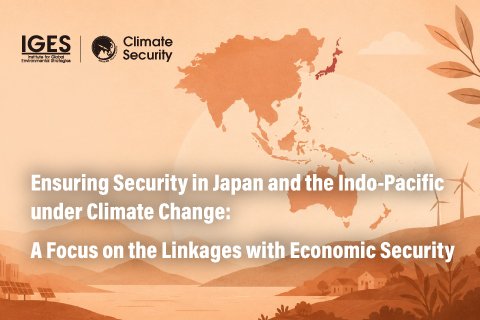
Ensuring Security in Japan and the Indo-Pacific under Climate Change: A Focus on the Linkages with Economic Security
The climate security featured page will share research findings and related information on climate security. We are exploring various topics, including international trends analysis, energy security, food security, climate-induced human mobility, cl
Project
Updated: August 2023
IGES Inputs to Asia-Pacific Forum on Sustainable Development (APFSD)
APFSD is an annual meeting convened by the United Nations Economic and Social Commission for Asia and the Pacific (UNESCAP) aimed at strengthening the region’s readiness for the United Nations High-level Political Forum on Sustainable Development.