Dr.
Akihisa KURIYAMA

Former Staff (from Nov 2010 - May 2025 )
Results 51 to 60 of 174 (Sorted by date)
Submission to Policy Process
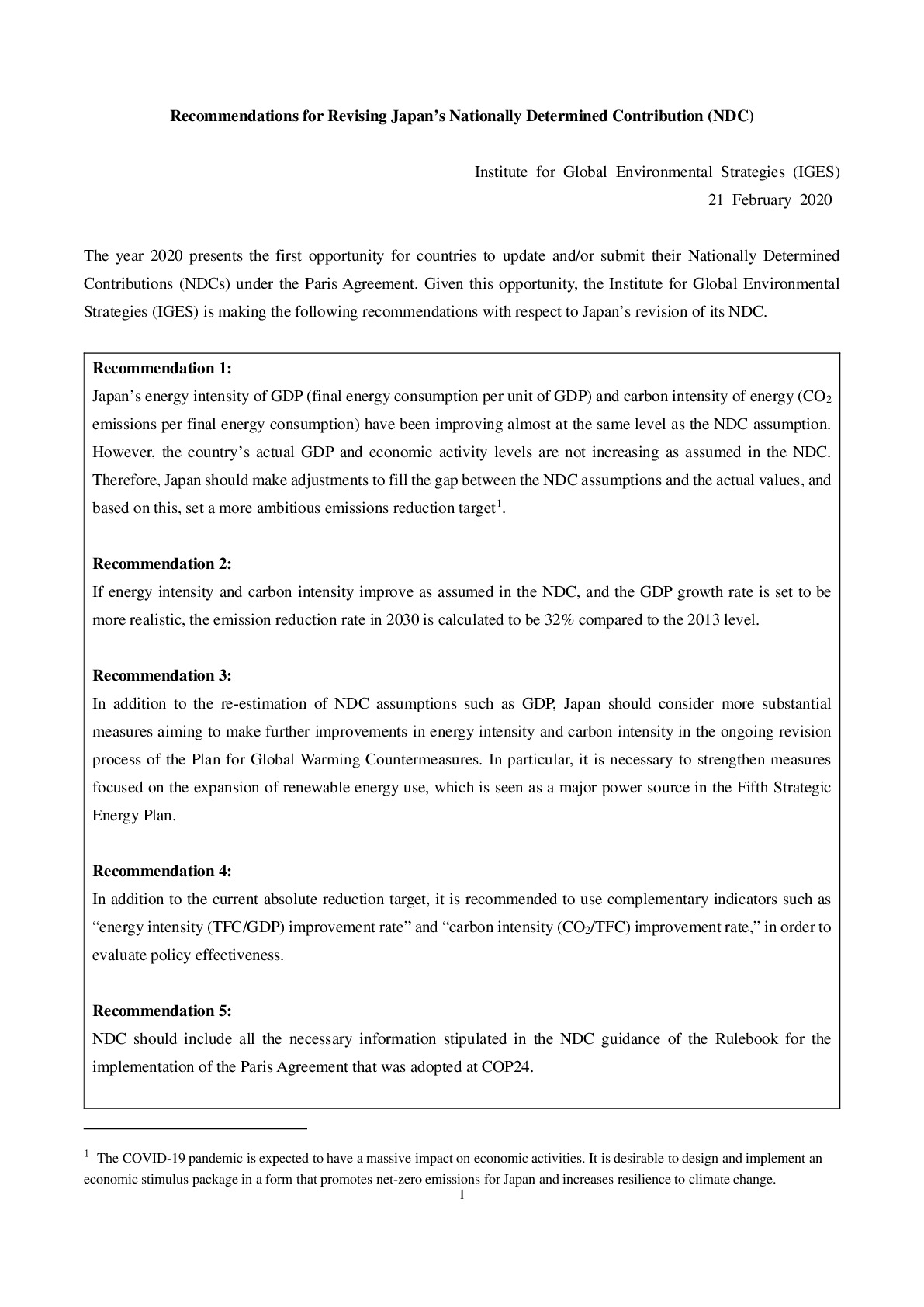
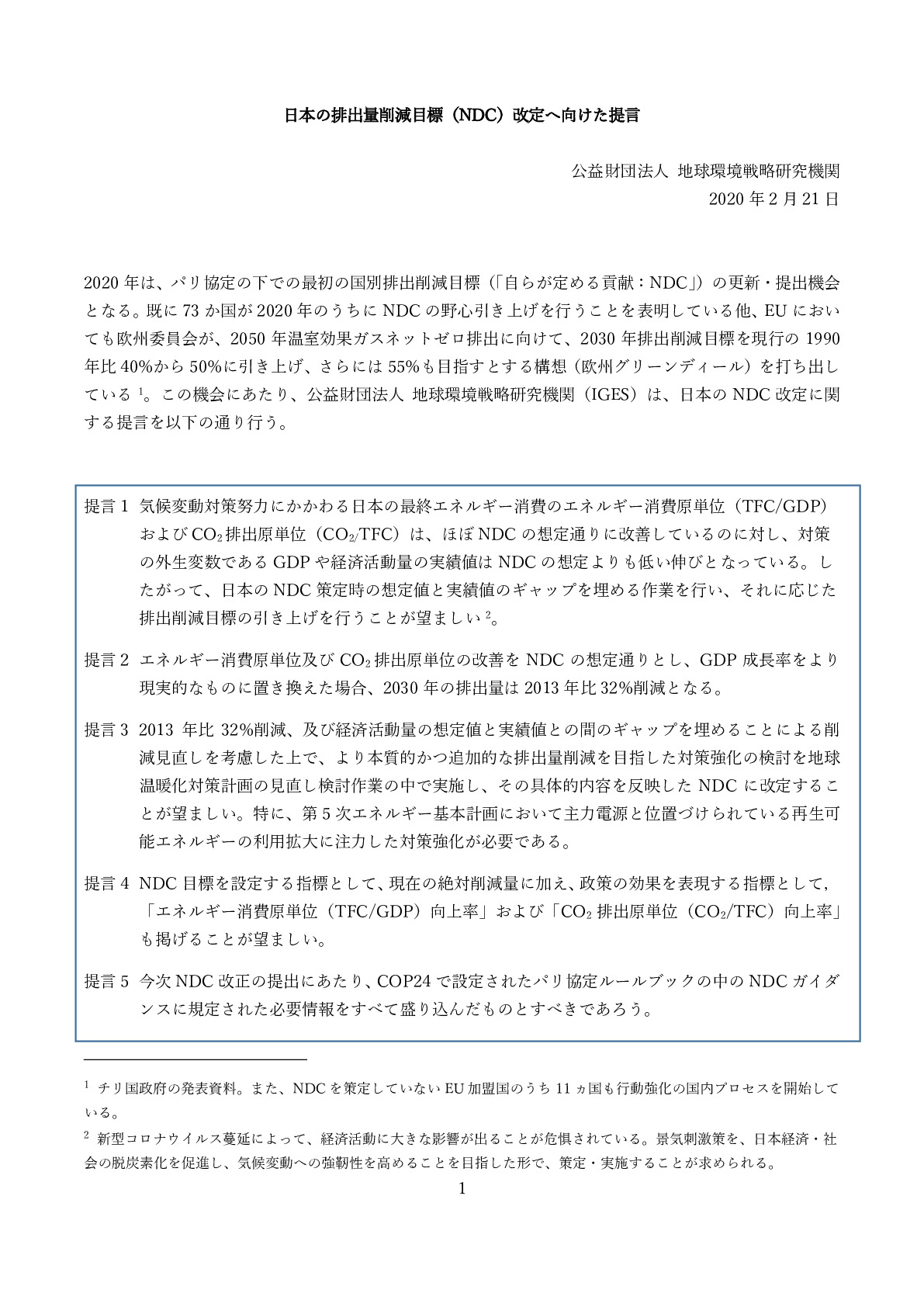
Japan's current NDC targets a 26% reduction in greenhouse gas emissions by 2030 compared to the 2013 level. However, it has become clear that there is room to raise this target by matching the economic growth assumptions made when the NDC was formulated with actual figures, and making them more realistic. Drawing on the study’s results, IGES...
Submission to Policy Process
現在の日本のNDCでは、2030年に2013年度比で温室効果ガス排出量26%削減を目標としていますが、NDC策定時の経済成長想定を実績値にあわせてより現実的な数値とすることで、目標には引き上げの余地があることが明らかになっています。IGESはその研究成果に基づき、経済成長想定をより現実的な数値にした場合の2030年削減量を示すと同時に、それをベースとして、さらなる引き上げを議論すべきであることを提言します。
Policy Report
Author:
United Nations Environment Programme [UNEP]
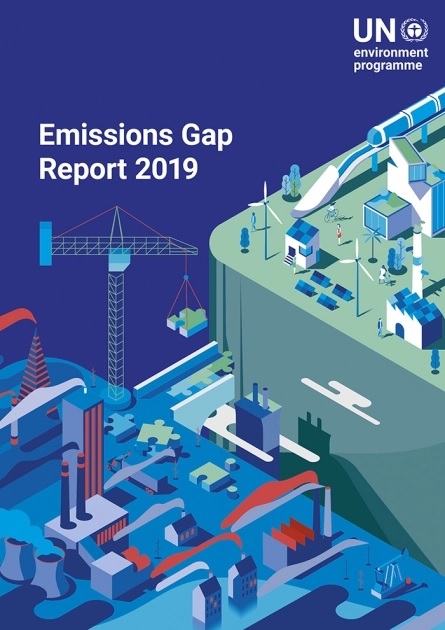
国連環境計画(UNEP)が発表した「Emissions Gap(排出ギャップ)Report 2019」エグゼクティブ・サマリーの日本語翻訳版(暫定非公式訳)。2018年に排出された温室効果ガス(GHG)の総量、今後予想される排出量及びパリ協定目標を達成するための排出量との差である「排出ギャップ」などについて様々な分析を行っている。特に、世界のGHG排出量の8割近くを占めるG20メンバーによる早急な取り組み強化の必要性、再生可能エネルギーの利用拡大、エネルギー効率化を検証し、世界の総排出削減を進め、排出ギャップを埋める野心的な方策を提案し、経済・社会全体の革新的な変化の必要性を強調している。
Presentation
Twelfth Annual Meeting of the IAMC
Contents of this presentation - Application of model results for transition analysis; An approach for feasibility studies - Focusing job issue (ca. Just Transition) to enhance the mitigation targets - Analyzing job impact at the national/sub-national context under the decarbonization of the power sector
Book Chapter
In Emission Gap Report 2019
Author:
Takeshi
Kuramochi
Michel
den Elzen
Peters
Glen
This chapter assesses the latest trends in greenhouse gas (GHG) emissions as well as progress of G20 economies towards both the Cancun pledges for 2020 and Nationally Determined Contributions (NDCs) for 2025 and 2030. Report can be download from here. https://www.unenvironment.org/resources/emissions-gap-report-2019
Peer-reviewed Article
In Energy Strategy Reviews
This paper explores Japan's energy and emissions-related choices up to 2050 using the Japan 2050 Low Carbon Navigator (Low Carbon Navigator), an energy and emissions scenario simulation tool based on the 2050 Pathways Calculator model. Using illustrative examples and scenarios, the paper demonstrates some unique features of the Low Carbon Navigator...
Presentation
7th International Symposium on Environmental Sociology in East Asia (ISESEA)
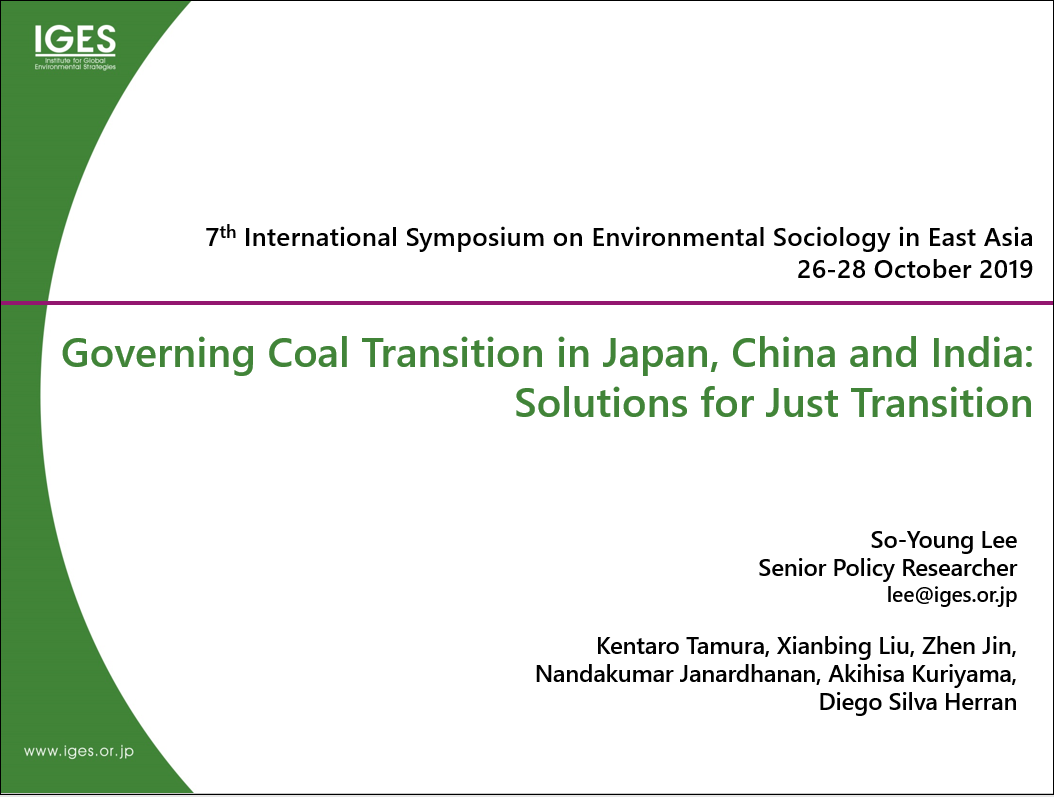
The Communique of the G7 Summit in 2018 reaffirmed their strong commitment to implement the Paris Agreement through reducing emissions while strengthening resilience and reducing vulnerability as well as ensuring a just transition. Discussions of climate and energy justice, the key basis of the aforementioned consideration, focus on who produced no...
Presentation
International Forum for Sustainable Asia and the Pacific 2019
“Just Transition” is an important, brand new concept to implement policies towards decarbonisation of the power sector (DPS) in Japan. However, a knowledge gap still remains between this concept and policy discussion at a practical level. Therefore, using the existing DPS scenarios and employment factors for the power sector based on extended input...
Presentation
BUAA-NIES Bilateral Workshop on Integrated Assessment of Health Co-benefits of Climate Change Mitigation Policy
This presentation highlights the following topics. - Relationships between 2030 mitigation target (NDC) and co-benefits such as health care and air pollution. - Assessment on the ambition of current Japan’s NDC by comparative study for model analysis and historical trend. - Showing an example on how to utilize or deliver the results from IAM models...
Results 1 to 2 of 2 (Sorted by date)
Project
Updated: July 2023

G7 (2023) Special webpage

The G7 Ministers' Meeting on Climate, Energy, and Environment was recently held in Sapporo, Japan, ahead of the G7 Hiroshima Summit on May 19-21. In this special issue, we provide in-depth coverage of the latest updates and insights from th
Project
Updated: March 2023

Net-zero: Towards 1.5°C Goal

In 2021, Japan announced its Green Growth Strategy, setting out a roadmap for key technologies in line with its commitment on carbon neutrality by 2050. Japan has embarked on several initiatives on transformative technology in key sectors, with the a