Search

Results 4971 - 4980 of 6464 (Sorted by date)
Discussion Paper
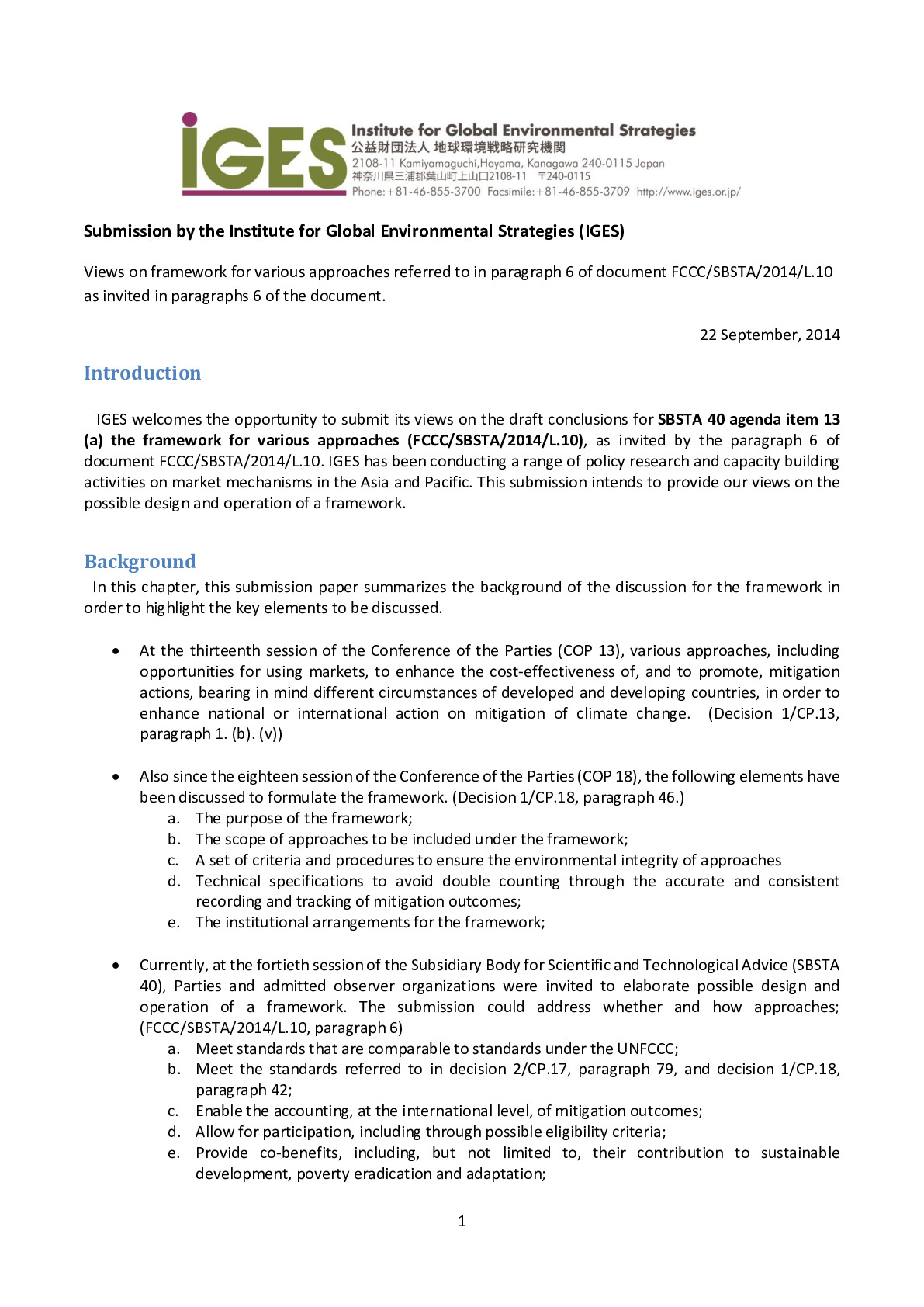
The FVA needs to support for transparency of INDCs. Since INDCs cover Economy-wide emission reduction targets (GHG targets) as well as Non-GHG targets such as energy targets, policy and project implementation, the scope of the FVA includes accounting framework for not only international transactions but also mitigation targets or actions under...
Research Report
The Asia Pacific Adaptation Network (APAN) was established in 2009 in response to the growing need for collaboration among different stakeholders engaged in climate change adaptation and related areas to build resilience of vulnerable human, ecosystems and economies to climate change. The network envisages achieving this through sharing knowledge...
Presentation
Asia-Pacific Climate Change Adaptation Forum 2014, 1-3 October 2014, Kuala Lumpur, Malaysia
Insurance thus far has not gained its deserving attention as an effective post-disaster recovery tool though the actual role of insurance is always after the disaster. Several bottlenecks that hinder the efficiency and efficacy of insurance for long-term recovery are discussed including improper insurance price signals, contract design aspects and...
Presentation
Asia-Pacific Climate Change Adaptation Forum 2014, 1-3 October 2014, Kuala Lumpur, Malaysia
Non-economic loss and damage have not been uniformly and sufficiently reported in various international and national disaster databases. There are challenges such as difficulty in estimating loss and damage and incorporating them in risk reduction decision making. The APN project aims to prioritize important non-economic loss and damage and...
Presentation
Asia-Pacific Climate Change Adaptation Forum 2014,
Author:
Ainun Nishat, BRAC University
The entire coastal belt of Bangladesh was already suffering from salinisation, caused by development and worsened by climate change. It used to be a freshwater ecosystem three or four decades ago but we had a lot of development work in the upstream area, and freshwater was reduced or supply was stopped. Salinity went up - then came sea-level rise...
Peer-reviewed Article
In APN Science Bulletin
Risk insurance can provide an effective means of catastrophic risk reduction and climate change adaptation in developing countries. Case studies from within and outside the Asia-Pacific region provide valuable lessons, which could be used for promoting risk insurance for future climate regimes. Issues such as high basis risk, lack of qualified...
Presentation
8th International Conference on Community Based Adaptation, Kathmandu, Nepal, 24-30 April 2014
Adaptation effectiveness indicators could vary by location, hazard under question, practices and stakeholders engaged. However, it is possible to identify a broad range of indicators that could be relevant to a range of conditions. A simplified AHP could be useful for prioritizing adaptation interventions at community level that could effectively...