Results 1 - 10 of 53 (Sorted by date)
Technical Report
Author:
Koji
Takakura
Sonam
Wangchuk
Tsheten
Wangchuku
Takahiro
Fukahori
Chhimi
Dorji
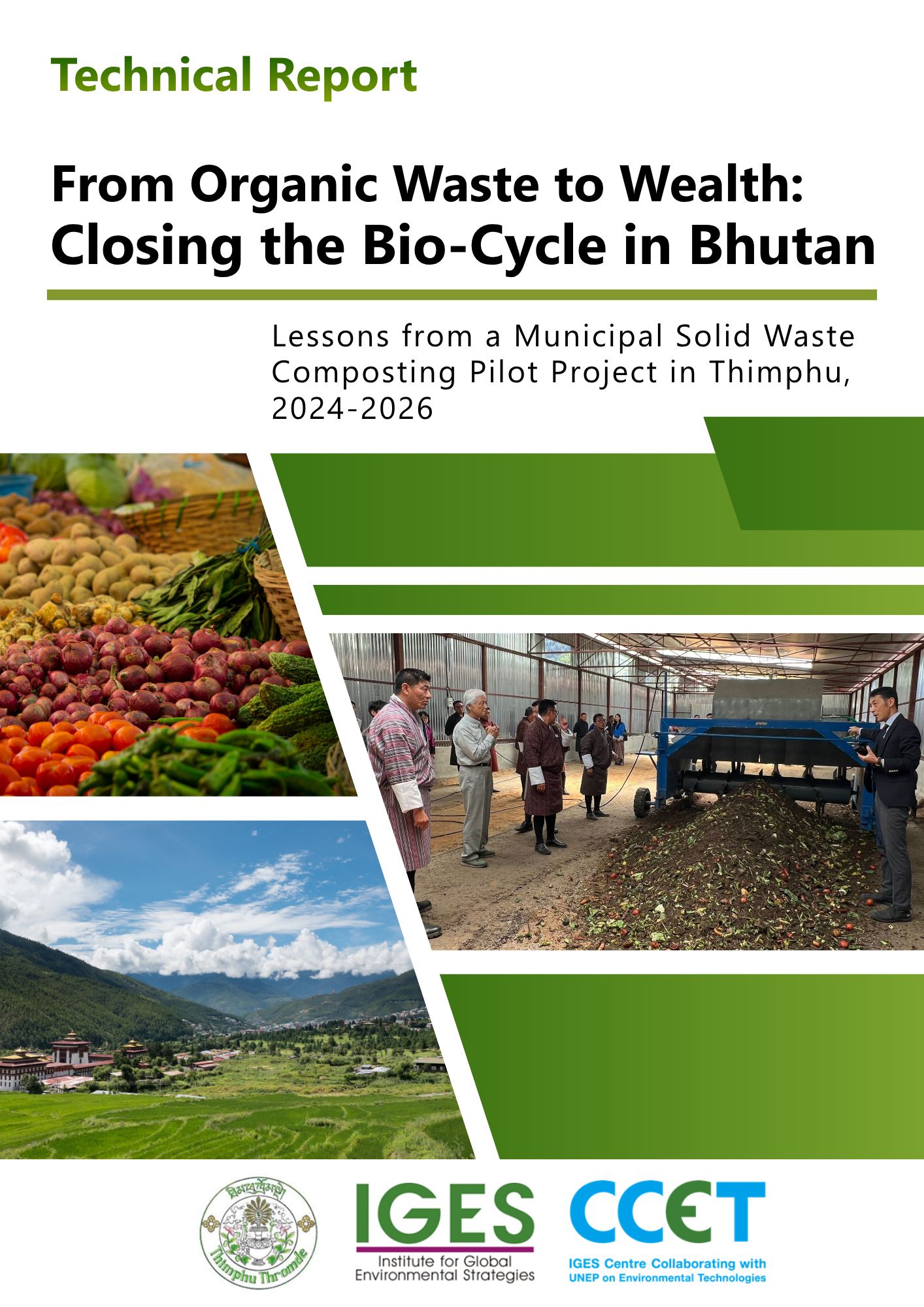
Bhutan faces mounting pressure on its municipal solid waste (MSW) management systems. Its capital city, Thimphu, generates approximately 50 tonnes of MSW per day, of which roughly 30 tonnes per day is organic (wet) waste that is currently deposited at the Memelakha landfill — an ageing open-dumpsite already well beyond its intended lifespan. At the...
Technical Report
Author:
Julie
Amoroso-Garbin
Jean
Paula Bermudez Regulano
Juhi
Bansal
Promit
Mookherjee
Viet Nam stands at a critical juncture. Its status as a global agricultural powerhouse faces an escalating threat from climate change. This case study outlines the strategic integration of food systems into Viet Nam’s National Adaptation Plans (NAP) and Nationally Determined Contributions (NDC), emphasizing the pivotal role of genebanks and seed...
Technical Report
Author:
Julie
Amoroso-Garbin
Jean
Paula Bermudez Regulano
Juhi
Bansal
Promit
Mookherjee
Lao PDR is at a pivotal moment in its development trajectory. As a least developed country (LDC) on track to graduate by 2026, its food systems face increasing pressure from climate change, structural transformation, and resource constraints. Agriculture remains central to livelihoods, food security, and poverty reduction, employing nearly three...
Technical Report
Author:
Jean
Paula Bermudez Regulano
Juhi
Bansal
Julie
Amoroso-Garbin
Promit
Mookherjee
As one of the world’s most climate-vulnerable nations and a country in which agriculture underpins the livelihoods of tens of millions, making food systems climate resilient is a key priority for Pakistan. This case study examines the strategic integration of food systems into Pakistan’s National Adaptation Plan (NAP) and Nationally Determined...
Technical Report
The global environmental governance landscape is undergoing a paradigmatic shift from state-centric pollution control to market-based Extended Producer Responsibility (EPR). This report provides an exhaustive analysis of the EPR landscape within the Indo-Pacific region, contrasting the mature, strict-liability frameworks of East Asia (Japan, South...
Technical Report
Author:
Rabia
Bano
Ayesha
Khan
Imran
Javed
This pilot project focuses on the underserved settlement of Bhutto Nagar in Sahiwal to address severe public health risks and environmental degradation. The program's core strategy involves formalizing the informal waste sector by organizing independent pickers into Waste Business Associations, providing them with professional training, safety gear...
Technical Report
Author:
This report evaluates a pilot project in Padang, Indonesia, that introduced the digital application to modernise community-based waste banks. The study explores how digital transformation can improve operational efficiency, data accuracy, and transparency within a circular economy framework. While the initiative successfully digitised thousands of...
Technical Report
Author:
Greg Lydka
Morris
Juan Carlos Arredondo
Brun
Valentina Hernandez
Gomez
Holly
Nicholson
The report focuses on three carbon project types with significant potential for ASEAN – REDD+, blue carbon and biochar – outlining their mitigation potential and the economic opportunity available for ASEAN Member States in harnessing carbon markets to meet their emissions objectives. It finds that, under the right conditions, carbon markets could...
Technical Report
Author:
Partnerships in Environmental Management for the Seas of East Asia (PEMSEA)
The Guidebook on the State of the River Basin (SORB) Reporting System is intended for local governments and/or river basin organizations in the East Asian Seas region currently or planning to implement integrated river basin management (IRBM)/integrated water resources management (IWRM) programs. The Guidebook provides guidance to local governments...
Technical Report
Author:
Andreas
Schmidt
Ajith
Edathoot
Rohini
Pradeep
Aparna
Unni
This technical report serves as a comprehensive guide, offering practical insights and methodologies for the implementation of decentralized wastewater management (DWM) systems within the ASEAN region. It aims to provide a flexible framework adaptable to the diverse environmental, cultural, and economic contexts of ASEAN countries—fostering...