

Director of AI and New Frontier Group
Research Topics & Areas of Expertise
- Artificial intelligence (AI) for sustainability decision support
- Machine learning for disaster forecasting, risk assessment, and resilience planning
- Geographic information system (GIS) spatial analysis
- Remote-sensing data analytics for environmental monitoring and disaster-impact assessment
- Natural language processing (NLP) for causal mapping, knowledge extraction, and systems analysis
- Network analysis, systems thinking, and integrated systems modelling
- AI-enabled knowledge systems, interactive analytics, and decision-support tools
- Sustainable Development Goal (SDG) indicators, interlinkages, and integrated assessment
- Climate-policy assessment, green-economy transitions, and environmental governance
- Energy-system scenario modelling and low-carbon transition pathways
- Water–food–energy nexus analysis and integrated resource planning
- Climate change, disaster risk reduction, and urban resilience
- Data integration, environmental information systems, and policy-relevant sustainability science
Education
i) Ph.D in Environmental Studies, Graduate School of Environmental Studies, Nagoya University, Japan;
ii) Master Degree in Environmental Science, College of Environmental Sciences, Peking University, Beijing, China;
iii) Bachelor Degree in Applied Mathematics, Department of Applied Mathematics and Physics, Beijing University of Chemical Technology, Beijing, China
Results 161 to 170 of 199 (Sorted by date)
Conference Proceeding

環太平洋産業連関分析学会第23回(2012年度)大会
経済のグローバル化にともない、ある国で起きている環境問題の責任を生産国、消費国でどのように負担すべきかが議論になっている。これまで産業連関分析を応用して、カーボンフットプリント推計が行われている。しかし、環境負荷が貿易の過程でどのように発生しているかについては、まだ十分解明されていない。すなわち、貿易にともなう環境負荷がA国で発生する場合、B国の最終需要がA国で生産を誘発した場合だけでなく、B国の最終需要がC国を迂回してA国で生産を誘発する場合もあるが、既存の分析方法では両者は十分には区別できない。そこで、本研究ではブロック構造経路分析を用いて、貿易で誘発されるCO2を貿易の段階別に分解した。分析ではアジア国際産業連関表を用いた...
Conference Proceeding
SEEPS
経済のグローバル化にともない、ある国で起きている環境問題の責任を生産国、消費国でどのように負担すべきかが議論になっている。これまで産業連関分析を応用して、カーボンフットプリント推計が行われている。 しかし、環境負荷が貿易の過程でどのように発生しているかについては、まだ十分解明されていない。すなわち、貿易にともなう環境負荷がA国で発生する場合、B国の最終需要がA国で生産を誘発した場合だけでなく、B国の最終需要がC国を迂回してA国で生産を誘発する場合もあるが、既存の分析方法では両者は十分には区別できない。 そこで、本研究ではブロック構造経路分析(Block SPA)を用いて、貿易で誘発されるCO2を貿易の段階別に分解することを目的とする。
Peer-reviewed Article
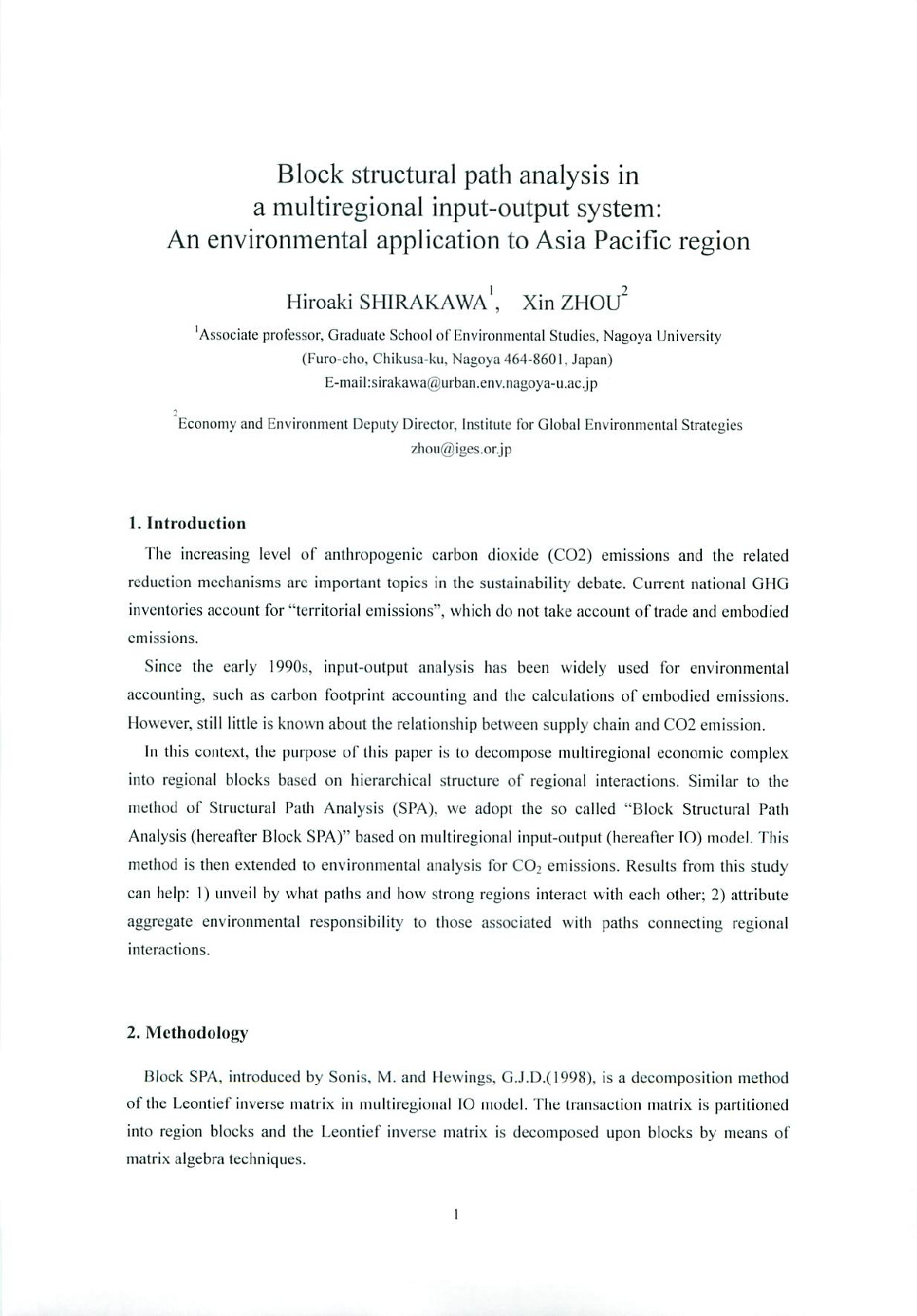
In 20th Conference of the International Input-Output Association
Growing regional inequality and environmental degradation associated with interregional trade in Asia Pacific Area has been considered one of the major barriers in achieving sustainable development. Decomposition of economic structure at the regional level can help analyze these problems. This study applies Block Structural Path Analysis to the...
Conference Paper
20th Conference of the International Input-Output Association
In 2005, the Chinese government set compulsory targets for energy-saving. The national target is a reduction of 20 percent energy consumption per unit of GDP by 2010 based on the level in 2005. The national target is disaggregated into provincial targets which range from 12 - 30 percent of reduction. This policy will have great influences on not...
Presentation
20th Conference of the International Input-Output Association
Growing regional inequality and environmental degradation associated with interregional trade in Asia Pacific Area has been considered one of the major barriers in achieving sustainable development. Decomposition of economic structure at the regional level can help analyze these problems. This study applies Block Structural Path Analysis to the...
Presentation
20th Conference of the International Input-Output Association
In 2005, the Chinese government set compulsory targets for energy-saving. The national target is a reduction of 20 percent energy consumption per unit of GDP by 2010 based on the level in 2005. The national target is disaggregated into provincial targets which range from 12 - 30 percent of reduction. This policy will have great influences on not...
Peer-reviewed Article
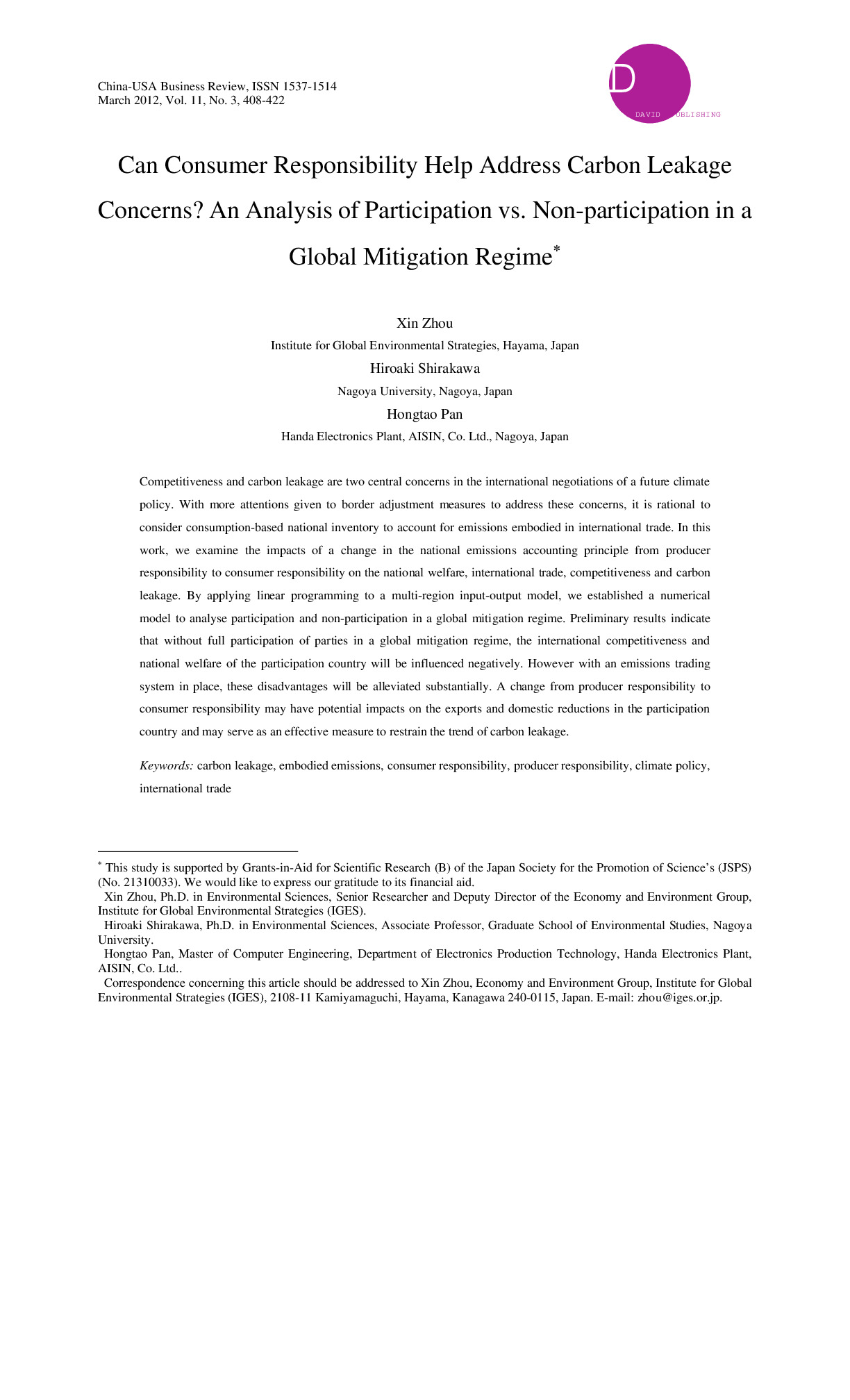
In China-USA Business Review
Competitiveness and carbon leakage are two central concerns in the international negotiations of a future climate policy. With more attentions given to border adjustment measures to address these concerns, it is rational to consider consumption-based national inventory to account for emissions embodied in international trade. In this work, we...
Book Chapter
In 中国省区间投入产出模型与区际经济联系
With the development of globalisation and the emergence of global environmental issues such as climate change, China has become an important country in many multi-regional economic analysis models, such as the multi-region input-output models and the CGE (computable general equilibrium) models. Since China has large regional disparity in terms of...
Book Chapter
In 中国省区间投入产出模型与区际经济联系(China's Interregional Input-Output Model and Interregional Economic Linkage)
Book Chapter
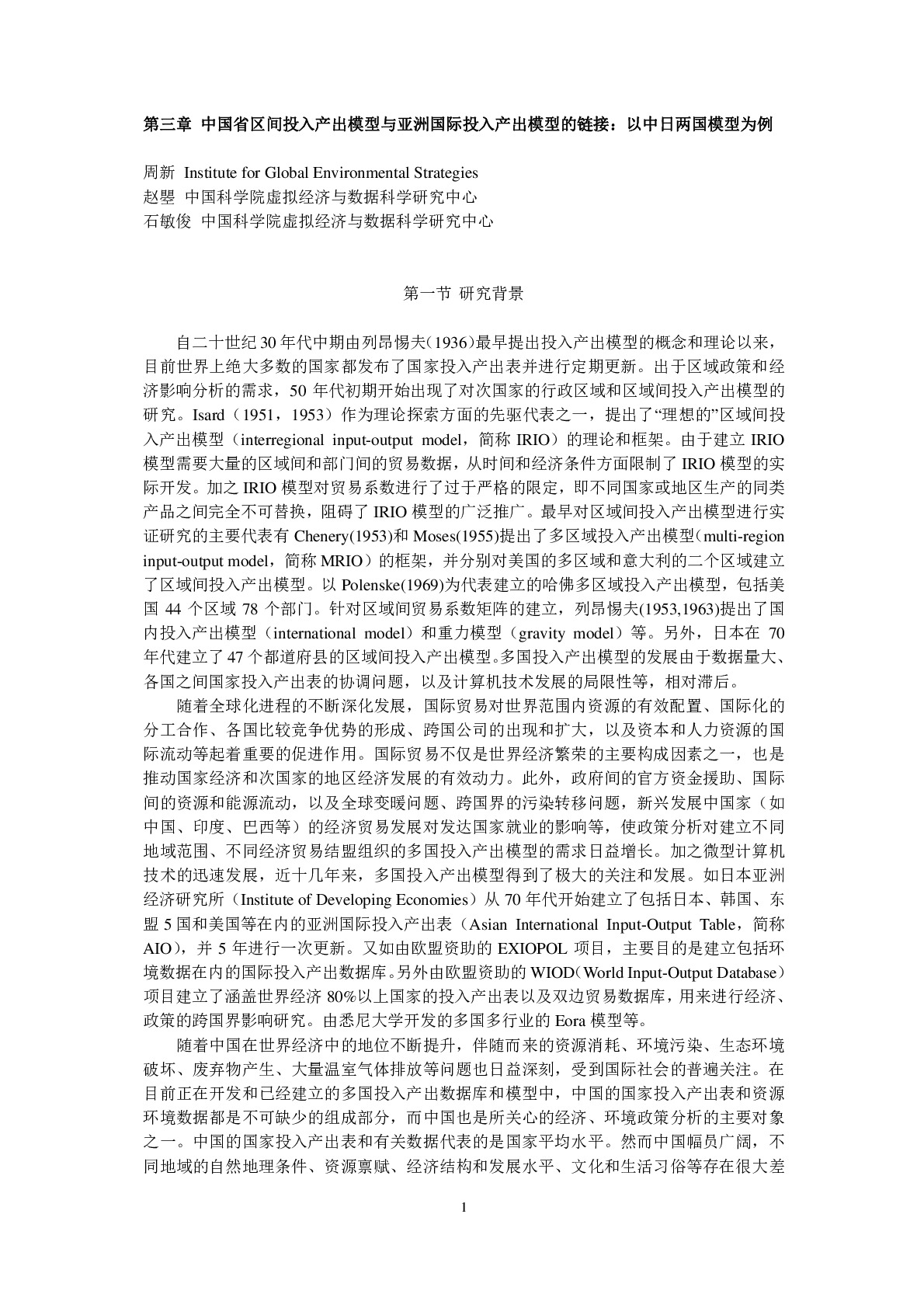
In 中国
This book chapter described the methodology to link a country's interregional input-output table with an international input-output table. The case of China's interregional input-output table and the Asian International Input-Output Table are used as an example to build such a link. In particular, the bilateral trade of China and Japan are used to...
No Projects Found.