

Programme Director
Research Topics & Areas of Expertise
3R Policy, Sustainable Resource Management, Extended Producer Responsibility (EPR), transnational environmental issues, Circular Economy, Sustainable Consumption and Production, Zero Emissions policy, marine plastic issues, industry and environmental issues, self-regulation, Ecological Modernization.
Education
- Dphil in International Relations, Centre for Culture, Development and Environment, University of Sussex, UK
- M.A. in Political Science, Graduate School of Political Science, Waseda University
- B.A. in Political Science, School of Political Science and Economics, Waseda University
早稲田大学政治経済学部政治学科(政治学士)卒業
早稲田大学大学院政治学研究科(政治学修士)修了
英国サセックス大学文化・開発・環境研究所(国際関係論博士)修了
Results 341 to 350 of 440 (Sorted by date)
Conference Paper

Presentation
FY 2011 Waste Management Course for Administrators for Sri Lanka
Policy Brief

In the last two decades policies based on extended producer responsibility (EPR) have been implemented for a wide range of products, especially in industrialised economies. Now, an increasing number of Asian economies similarly find themselves facing increasing amounts of difficult-to-treat waste and associated health, social and environmental...
Book Chapter

The report “Resource Efficiency: Economics and Outlook for Asia and the Pacific (REEO)” is the result of a unique collaboration between four leading regional institutes. Main author is the Australian research organization SCIRO (Commonwealth Scientific and Industrial Research Organizsation) and the contributors include the Institute for Global...
Policy Brief

ここ20年ほどで、先進国を中心に様々な製品を対象にしたEPR政策が実施されてきた。そして近年、アジア発展途上国では、経済発展に伴い、処理困難な廃棄物の急増とそれに伴う健康・社会・環境リスクの増大、さらに資源需要の急増といった課題に直面する場面が増えてきた。そうした国の多くで、E-wasteの管理を目的として、EPRの法制度化が推進または検討されている。 アジア発展途上国政府は、EPR政策の計画・実施面での課題を考慮に入れた上で、その効果的な導入に向けて、どのようなアプローチを取ればよいのだろうか?本ポリシー・ブリーフでは、まずアジア発展途上国の現状と課題を検証し、その後E-waste管理の段階的導入アプローチを提案する。 Remarks: English version: http:/...
Working Paper
Presentation
Lecture to students from Graduate School of Environmental and Energy Engineering, Waseda University
Peer-reviewed Article
In S.A.P.I.EN.S
After the earthquake, tsunami and Fukushima nuclear incident in North East Japan in March 2011, there is increasing discussion of reconstructing the damaged areas in an environmentally sustainable manner in Japan. The politicians are beginning to argue that this is an opportunity to reconstruct Japanese society in a more sustainable manner. This...
PR, Newsletter or Other
Peer-reviewed Article
In Waste Management & Research
The amount of e-waste is growing rapidly in developing countries, and the health and environmental problems resulting from poor management of this waste have become a concern for policy makers. In response to these challenges, a number of Asian developing countries have been inspired by policy developments in OECD countries, and have drafted...
Results 1 to 1 of 1 (Sorted by date)
Project
Updated: March 2026
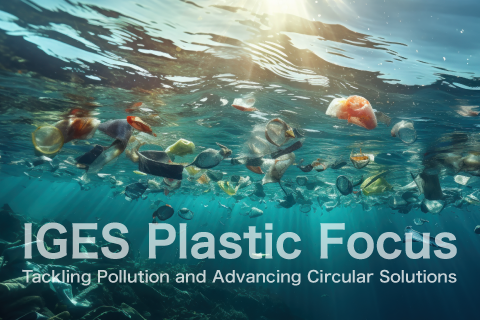
IGES Plastic Focus: Tackling Pollution and Advancing Circular Solutions
This special webpage highlights global developments in addressing plastic pollution, focusing on the growing importance of the circular economy as a solution. It also showcases IGES contributions to this agenda, including its environmental policy...