

Programme Director
Research Topics & Areas of Expertise
3R Policy, Sustainable Resource Management, Extended Producer Responsibility (EPR), transnational environmental issues, Circular Economy, Sustainable Consumption and Production, Zero Emissions policy, marine plastic issues, industry and environmental issues, self-regulation, Ecological Modernization.
Education
- Dphil in International Relations, Centre for Culture, Development and Environment, University of Sussex, UK
- M.A. in Political Science, Graduate School of Political Science, Waseda University
- B.A. in Political Science, School of Political Science and Economics, Waseda University
早稲田大学政治経済学部政治学科(政治学士)卒業
早稲田大学大学院政治学研究科(政治学修士)修了
英国サセックス大学文化・開発・環境研究所(国際関係論博士)修了
Results 281 to 290 of 440 (Sorted by date)
Discussion Paper
Editor:
This report introduces factsheets on 11 different indicators for monitoring 3R and waste management policy implementation. The report is based on a research project of the Asia Resource Circulation Policy Research Group, coordinated by Institute for Global Environmental Strategies and funded by the FY 2012 and FY 2013 Asia Resource Circulation...
Issue Brief
Material Flow Analysis/Accounting (MFA) is one of the analytical tools that make it possible to monitor countries’ resource consumption trend and efficiency in resource use at the macro level. It uses already available production, consumption and trade data in combination with environmental statistics (OECD 2008). In principle, MFA can show not...
Issue Brief
The indicator “co-benefits of the 3Rs (reduce, reuse, recycle) of municipal solid waste on climate change mitigation” aims to maximize use of resources which can significantly contribute not only to reduce GHG emissions but also to receive other co-benefits such as creating green jobs, improving social well-being, reducing health risks, enhancing...
Discussion Paper

Editor:
Ryoko
SEGUCHI
Th is report was developed by Friends of the Earth Japan (FoE Japan) and the Institute for Global Environmental Strategies (IGES) with updated case studies as an English-language version of the Japanese report “Yori sukunai shigen de yori yutakana kurashi wo (A Richer Life with Fewer Resources),” published by FoE Japan in March 2013. This report...
Presentation
5th Regional 3R Forum in Asia and the Pacific
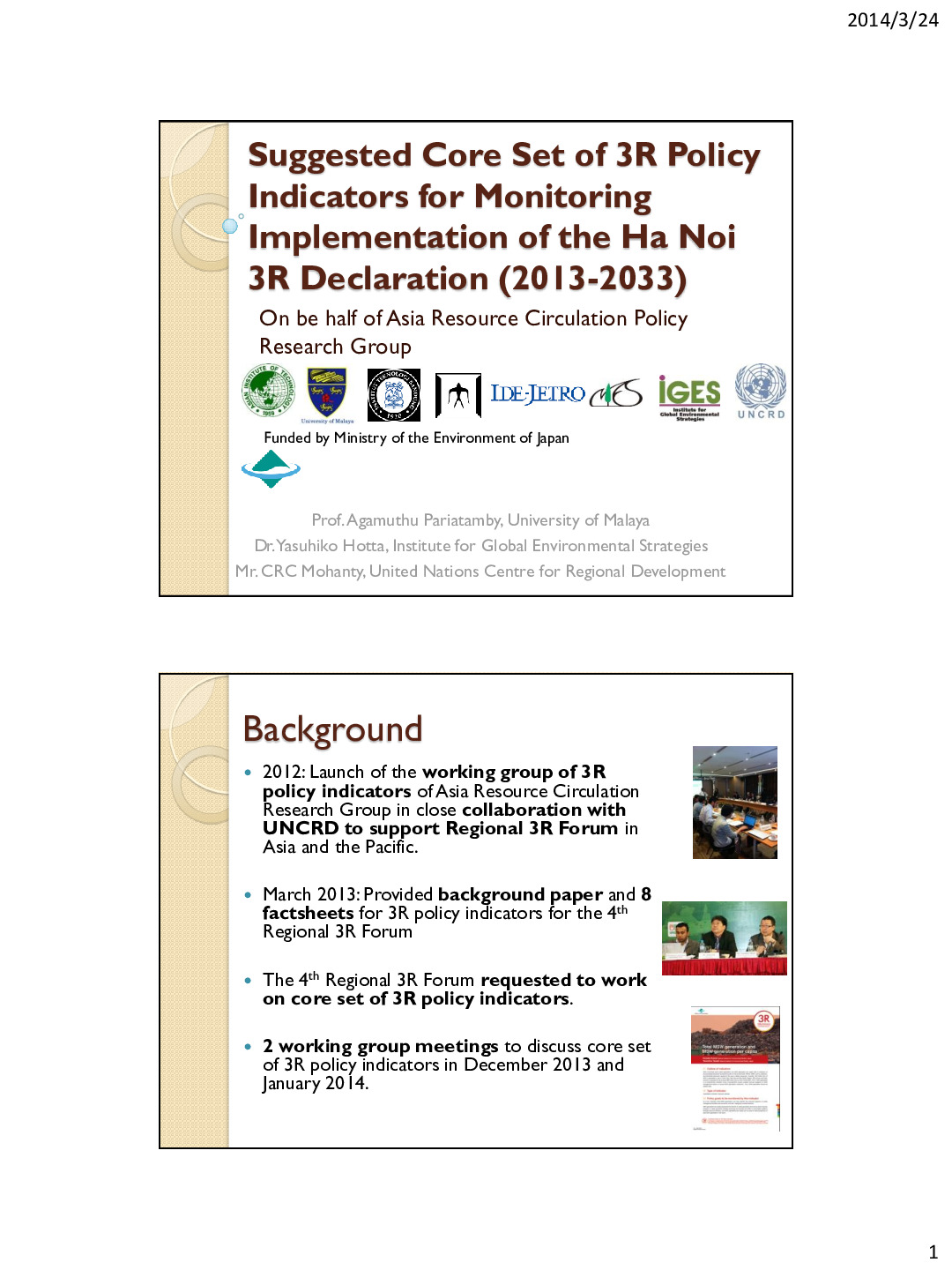
This presentation introduced core set of nine 3R policy indicators for monitoring implementation of the Ha Noi 3R Declaration on be half of Asia Resource Circulation Policy Research Group.
Discussion Paper
The 5th Regional 3R Forum in Asia and the Pacific, Surabaya, Indonesia, February 25-27, 2014
This background paper was prepared by experts of the Asia Resource Circulation Policy Research Group to showcase a choice of core set of policy and performance indicators on the 3Rs and resource efficiency with explaining reason, challenges and practical advantages for using these indicators. The report is based on a research project of the Asia...
Discussion Paper
Case study prepared for the OECD
The paper was prepared as a case study for OECD for designing updated guiding principles for EPR design and implementation. The paper was a background paper for Global Forum on Environment: Promoting Sustainable Materials Management through Extended Producer Responsibility (EPR) held in June 2014.
Book Chapter
In Waste as a Resource
The key challenges in waste management facing rapidly developing economies are the consideration of increasing resource consumption and waste generation, as well as the establishment of a ‘‘sound material cycle society’’. The latter refers to the concept of promoting a social change in which the consumption of natural resources is minimised and the...
Presentation
The 4th Meeting Working Party on Resource Productivity and Waste, Environment Policy Committee, OECD
Presented a case study of EPR application in Japan for the Working Party on Resource Productivity and Waste under Environment Policy Committee of OECD.
Presentation
Results 1 to 1 of 1 (Sorted by date)
Project
Updated: March 2026
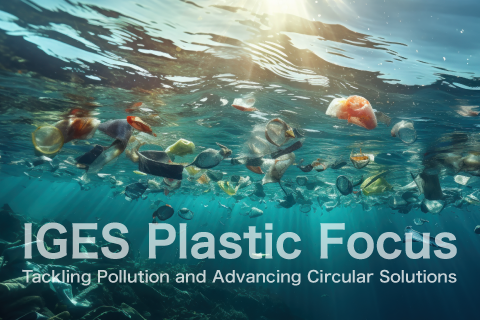
IGES Plastic Focus: Tackling Pollution and Advancing Circular Solutions
This special webpage highlights global developments in addressing plastic pollution, focusing on the growing importance of the circular economy as a solution. It also showcases IGES contributions to this agenda, including its environmental policy...