- 日本語


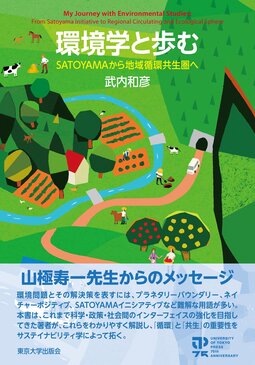
本書は、2010年に愛知県名古屋市で開催された生物多様性条約第10回締約国会議(COP10)に出席して以降の四半世紀に及ぶ著者の環境学に対する取り組みの歴史を振り返り、この分野における科学と政策のインターフェース強化に努めてきた自らの歩みを振り返ったものである。この時期は、国立大学法人化後の東京大学教授として初めて、東京大学教授と日本に本部を置く唯一の国連組織である国連大学の副学長を兼務し、多忙ながらも充実した研究者生活を過ごしていた。その当時から最近までの著者の主な研究・社会実践活動について、その成果を取りまとめたものである。
COP10の前後に著者は、中央環境審議会の委員(後に会長)や食料・農業・農村審議会委員に就任し、日本の環境政策や農業環境政策についてアドバイスを行う立場にあった。その立場で発言してきたのが、日本や世界の研究仲間たちと一緒に提案した日本の里地里山の世界への発信や国連食糧農業機関(FAO)が認証する世界農業遺産の日本での認定に向けた取り組みの推進である。COP10では、里地里山の概念を世界の他の国々とも共有し、世界的な保全・活用運動へと展開することを意図したSATOYAMAイニシアティブ国際パートナーシップ(IPSI)が発足し、現在まで活発に活動を続けており、著者もその一員として、発足以来、世界や日本の各地で開催される専門家会合に積極的に参加している。
中央環境審議会会長の立場で著者が議論を先導したのが、統合的アプローチの推進である。脱炭素、資源循環、自然共生の統合による環境政策の体系化に向けた議論を先導した。こうした発想の原点には、ストックホルムレジリエンスセンター所長時代のヨハン・ロックストローム博士らによって2009年に提唱された「プラネタリーバウンダリー」の考え方がある。この考え方は、地球の限界を示す気候変動、生物圏の一体性、生物地球科学フローの変化など、9つのバウンダリーを定量的に示したものであり、その数値については、最新のデータへの更新が今日まで図られている。また2015年には、国際的に著名な学術誌『ランセット』が「プラネタリーヘルス」という、地球の健康と人々の健康が不可分なものと見なす新しい考え方を提唱し、国際社会で定着しつつある。
プラネタリーバウンダリーに代表される統合的アプローチを地域スケールで展開したのが、著者が中央環境審議会会長としてとりまとめた『第5次環境基本計画』である。この計画では、ローカルなスケールでの環境政策の統合化を行うための「地域循環共生圏」の概念を提唱した。その結果、日本各地で環境政策と地域政策の融合が進み、これまで以上に具体的な統合的環境政策を展開する基盤が整った。現在は、第6次環境基本計画へと発展し、ウェルビーイング(高い生活の質)の実現を目指す地域環境政策の展開へと発展している。現在、地域循環共生圏の概念は、東南アジアを中心に世界的にも展開しており、統合的アプローチを前提とした国際連携の広がりも見られる。
This book reflects on the author’s quarter-century journey with environmental studies, focusing particularly on the period following the 10th meeting of the Conference of the Parties to the Convention on Biological Diversity (CBD COP10) held in Nagoya, Aichi Prefecture in 2010. It details various endeavors to strengthen the science-policy interface in this field. During this period, the author led a busy yet fulfilling academic life as a Professor at the University of Tokyo and Vice-Rector of the United Nations University (Aoyama, Tokyo), the only UN organization headquartered in Japan. He was the first professor to concurrently hold both positions following the university’s transition to a national university corporation. This book brings together the outcomes of major research and social practice activities from that time up to the present.
Around the time of COP10, the author was appointed as a member (and later Chair) of the Central Environment Council and as a member of the Council for Food, Agriculture and Rural Areas Policies, providing advice on Japan’s environmental and agri-environmental policy. In these roles, he advocated for key initiatives, including the global dissemination of Satochi-Satoyama, which he had proposed with research colleagues in Japan and internationally, as well as efforts to secure designation in Japan for FAO’s Globally Important Agricultural Heritage Systems (GIAHS). At COP10, the International Partnership for the Satoyama Initiative (IPSI) was launched to share the concept of Satochi-Satoyama worldwide and to expand into a global initiative for conservation and sustainable use. IPSI remains highly active to this day, and since its inception, the author has actively participated in expert meetings held in Japan and around the world as a member.
As Chair of the Central Environment Council, he spearheaded discussions on promoting an integrated approach, leading debates aimed at systematizing environmental policy through the integration of decarbonization, resource circulation and living in harmony with nature. The origin of this idea lies in the concept of “planetary boundaries”, proposed in 2009 by a group of scientists led by Dr. Johan Rockström, the director of the Stockholm Resilience Centre at that time. This concept quantitatively defined nine planetary boundaries, including climate change, biosphere integrity, and biogeochemical flows, with these numerical values continually updated to reflect the latest data up to the present. Furthermore, in 2015, the internationally renowned academic journal, The Lancet, introduced the new concept of “planetary health”, which views the health of the Earth and human health as inextricably linked – a concept that is becoming increasingly established in the international community.
The Fifth Basic Environment Plan, which the author led as Chair of the Central Environment Council, represents the application of an integrated approach, exemplified by planetary boundaries, at the regional scale. This Plan introduced the concept of the “Regional Circulating and Ecological Sphere” (Regional CES) to integrate environmental policies at the local level. Consequently, this fostered the integration of environmental and regional policies throughout Japan, establishing a solid foundation for implementing far more concrete and integrated environmental policies. It then evolved into the Sixth Basic Environment Plan, advancing toward regional environmental policies aimed at realizing well-being (quality of life). Today, the concept of Regional CES is expanding globally, particularly in Southeast Asia, with growing international collaboration built upon this integrated approach.
- 日本語