- Chinese, Simplified
Volume (Issue): Vol. 22, No. 6
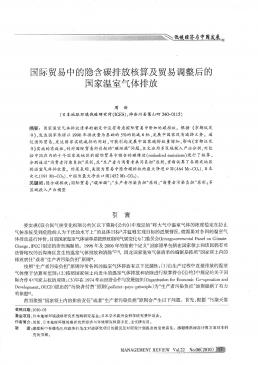


Current national GHG inventory which is based on producer responsibility does not consider emissions embodied in international trade. According to the Kyoto Protocol, industrialised countries have committed to collectively reduce their GHG emissions to an average of 5% against 1990 levels over the period 2008-2012. The Protocol does not commit developing countries to do so. Due to the differences in international commitment to domestic mitigation among parties, industrialised countries may shift their carbon-intensive production to developing countries where domestic climate policy is not in place based on the “pollution heaven hypothesis”, and import corresponding products. Emissions reduced in Annex I countries through offshore carbon-intensive production and international trade will, however, generate elsewhere, in particular from developing countries. This potential trend of relocation has led to the concern of carbon leakage, which will influence the effectiveness of implementation of the Kyoto Protocol. There is a large body of literature discussing this issue however it has yet to receive proper attention under the climate regime. To address emissions embodied in international trade, we apply a multi-region input-output model to calculate emissions embodied in ten selected countries, including China and other major Asian countries and USA. Based on two responsibility principles, viz. consumer responsibility and shared producer and consumer responsibility, national GHG inventories are adjusted for trade to generate national responsible emissions account. The results indicate that in terms of trade balance of embodied emissions, USA, Japan and Singapore have deficits while other economies, in particular China, have trade surplus. USA had the biggest net imports of embodied carbon (-464 Mt-CO2), followed by Japan (-191 Mt-CO2). China had the biggest net exports in terms of embodied emissions (452 Mt-CO2). This paper can be used by domestic climate policy makers and negotiators who are considering address the concern of carbon leakage at the global climate regime.
- Chinese, Simplified
Volume (Issue): Vol. 22, No. 6