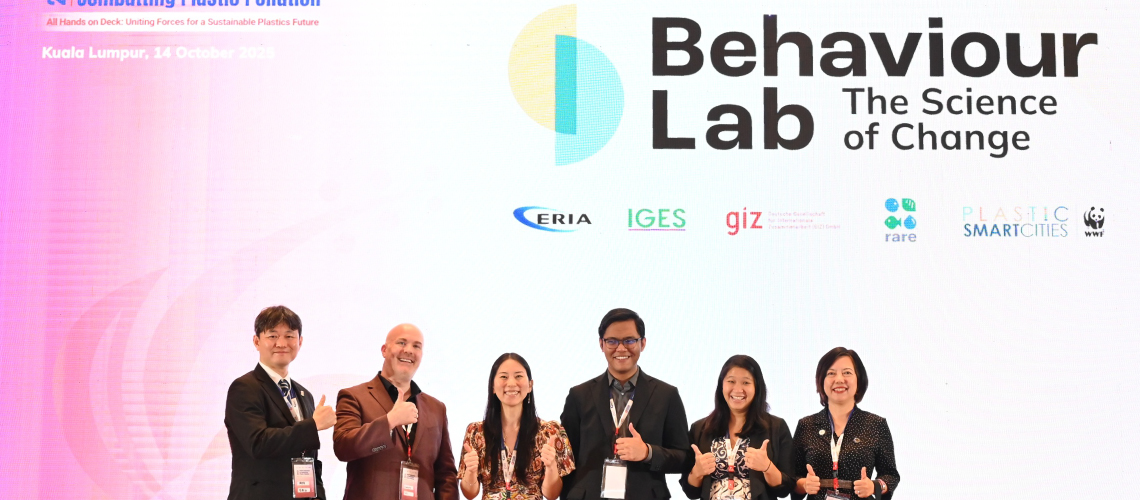
Photo: Behaviour Lab Partnership was launched on 14 October 2025, with the representatives of all five official partners joining on stage
Kuala Lumpur, Malaysia, 14 October 2025
The Behaviour Lab Partnership, a collaborative initiative led by IGES and four major regional non-governmental actors, was officially launched during the ASEAN Conference on Combatting Plastic Pollution (ACCPP) 2025. The Partnership will build capacity in ASEAN countries around the application of behavioural science tools to tackle plastic consumption and waste behaviours.
During the ACCPP’s plenary session “The Science of Change – Launching the Behaviour Lab Partnership in ASEAN,” representatives from the five founding organisations highlighted how behavioural science can be a powerful tool to address global sustainability challenges, including plastic pollution. However, its application to plastic waste issues in the ASEAN region remains limited. To help bridge this gap, the partners launched the Behaviour Lab, which will work alongside stakeholders across ASEAN to develop regional good practices and contribute to the global dialogue.
IGES signed a Memorandum of Understanding (MoU) with ERIA’s Regional Knowledge Centre for Marine Plastic Debris, Rare’s Center for Behavior & the Environment, WWF’s Plastic Smart Cities initiative, and the Deutsche Gesellschaft für Internationale Zusammenarbeit (GIZ) in October 2025 to formalise their collaboration. In this MoU, partners committed to three years of joint action, including events, research, and funding mobilisation to support their shared mission.
Through the Behaviour Lab, partners will unite their efforts to tackle plastic pollution through a behaviour-centred approach. Key objectives of the partnership include:
- Promote knowledge exchange and joint learning across public, private, and civil sectors.
- Strengthen inter-organisational collaboration across the ASEAN region to support sustainable behaviour change.
- Co-develop materials to inform and equip policy change, public engagement, and sustainable business models.
As a concrete step toward achieving these objectives, the Behaviour Lab partners will release a Monitoring and Evaluation Framework in 2026. This framework will be an open-access tool for practitioners in the ASEAN region and beyond.
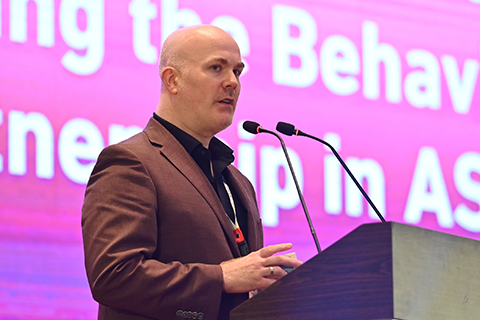
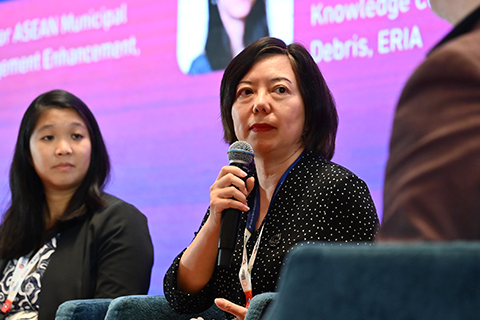
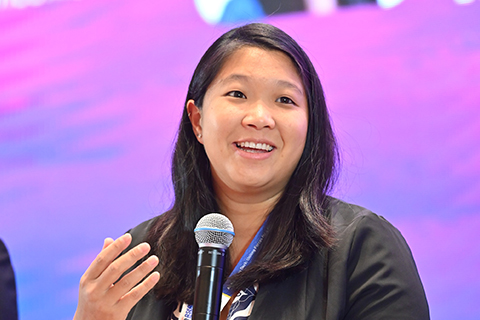
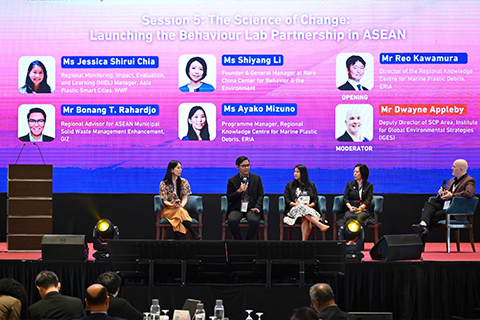
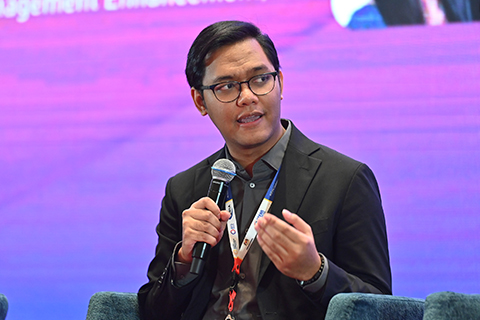
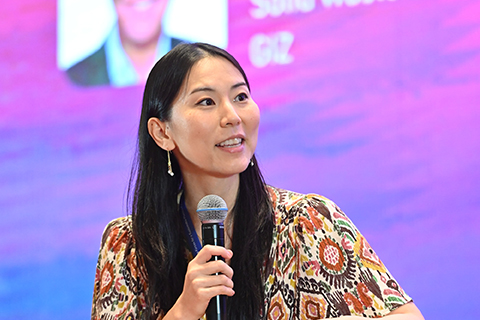
Photo: Session 5 of ACCPP, where five partners shared their ongoing activities and plans for joint actions in ASEAN. Top row from left to right: Dwayne Appleby, Deputy Director, Sustainable Consumption and Production Unit, Institute for Global Environmental Strategies (IGES); Shiyang Li, General Manager, Rare China Center for Behavior; Jessica Shirui Chia, Regional Monitoring, Impact, Evaluation, and Learning (MIEL) Manager, WWF Plastic Smart Cities
Bottom row from left to right: Panel discussion; Bonang Titian Rahardjo, Regional Advisor for ASEAN Municipal Solid Waste Management Enhancement, GIZ; Ayako Mizuno, Programme Manager, RKC-MPD, ERIA.
The Behaviour Lab is part of a suite of projects, strengthening IGES’s efforts to address plastic pollution in the ASEAN region. It grew out of IGES’s Breaking the Plastic Habit in ASEAN project series, in partnership with ERIA, and supported in the second phase by Rare’s Center for Behavior & the Environment. This project series has implemented 10 pilot projects across six ASEAN countries to gain a deeper understanding of the motivations and barriers around plastic consumption and waste. Pilots have been conducted in educational institutions, local markets, established businesses, and among startups.
The second phase of the Breaking the Plastic Habit project series will release a synthesis report in February, 2026, followed by a series of case studies co-developed with Rare’s Center for Behavior & the Environment. A third phase of the project is planned for 2026-2027 and will focus on engaging and supporting policymakers in ASEAN Member States.