- English


The intensification of agriculture, coupled with unregulated fertilizer application and groundwater overexploitation,
has led to widespread nitrate (NO3 ) contamination in many agrarian regions, including the Malwa
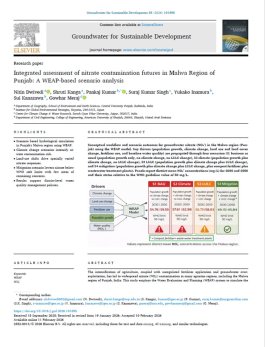
region of Punjab, India. This study employs the Water Evaluation and Planning (WEAP) system to simulate the spatio-temporal evolution of surface-water nitrate pollution under diverse socio-environmental scenarios. Using an integrated modelling framework, historical datasets on climate, land use/land cover (LULC), population, fertilizer application, river discharge and water quality were combined with future projections for 2030 and 2050. The WEAP model was calibrated and evaluated using observed monthly streamflow and nitrate concentration data for a combined two-year period (2020–2021). Hydrological calibration demonstrated excellent performance, with a root mean square error (RMSE) of 16.22 m3/s, Nash Sutcliffe Efficiency (NSE) of 0.998, coefficient of determination (R2) of 0.9996, and percent bias (PBIAS) of 3.55%. Water-quality calibration for nitrate yielded an RMSE of 2.43 mg/L, an NSE of 0.92, an R2 of 0.93, and a PBIAS of 4.12%, indicating strong agreement between observed and simulated nitrate concentrations. Four distinct scenarios were constructed: business-as-usual (S1), climate-inclusive (S2), land-use inclusive (S3), and an integrated management scenario (S4) incorporating compost fertilizer and wastewater treatment plants (WWTPs).
Scenario analysis revealed that, in the absence of mitigation, nitrate concentrations may increase by up to 35% by 2050, with the highest enrichment observed under the S2 due to enhanced leaching and altered hydrological regimes. In contrast, the S4 results in substantial reductions in nitrate across most districts, frequently bringing concentrations below the WHO threshold of 50 mg/L. The findings highlight the critical role of integrated nutrient management, wastewater treatment, and land-use planning in mitigating future risks of nitrate. This study provides a transferable, scenario-based modelling framework to support evidence-based water-quality policy formulation in groundwater-stressed agricultural regions.
- English