Background
Gender and social inequalities remain deeply embedded in waste management systems, particularly in developing and emerging economies where informal waste workers play a central role in collection, sorting and recycling activities. Women are significantly present in the informal waste sector and are often responsible for household-level waste management; however, their contributions, needs and perspectives are frequently overlooked in municipal waste services, policy design and decision-making processes. As countries increasingly adopt circular economy approaches and Extended Producer Responsibility (EPR) schemes, there is a growing risk that existing gender and social inequalities may be reinforced if informal workers are not adequately acknowledged and integrated into formal waste management systems.
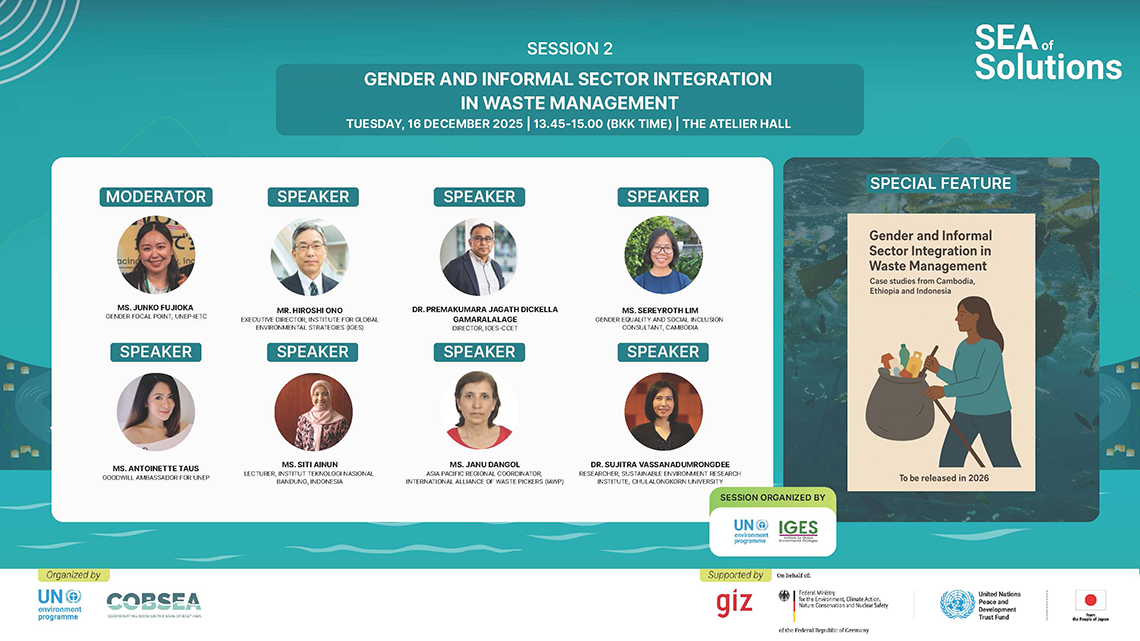
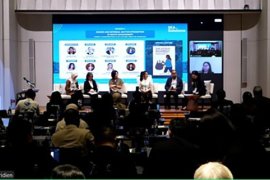
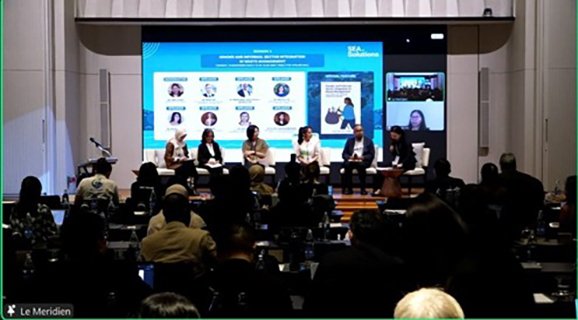
In response to these challenges, a dedicated session titled “Gender and Informal Sector Integration in Waste Management” was jointly organised in Bangkok from 16 to 17 December 2025 by the International Environmental Technology Centre of UNEP (UNEP-IETC) and the IGES Centre Collaborating with UNEP on Environmental Technologies (IGES-CCET). The session is part of the 2025 SEA of Solutions Forum, jointly convened by the United Nations Environment Programme (UNEP) and the Coordinating Body on the Seas of East Asia (UNEP-COBSEA). Moreover, this sixth edition of the SEA of Solutions Forum builds on the longstanding collaboration between UNEP Regional Office for Asia and the Pacific (UNEP ROAP) and UNEP-COBSEA to advance practical solutions on plastics and marine litter in the East Asian Seas region.
The session also presented preliminary findings from a forthcoming joint UNEP-IETC and IGES-CCET report, drawing on emerging experiences and lessons from selected country contexts.
Intent
The session aimed to support the integration of gender and informal sector perspectives into waste management policy and practice by sharing emerging evidence, case-based experiences and practical approaches. It contributed to ongoing regional and national efforts to promote inclusive and just transitions in waste management and circular economy systems, particularly in the context of expanding EPR frameworks across Southeast Asia.
Key Highlights
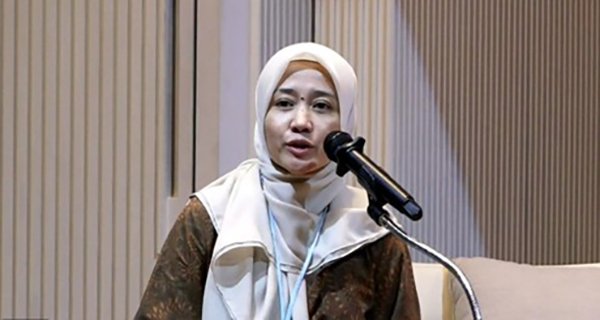
- The session highlighted that waste management is not only a technical or environmental issue but is deeply shaped by gender norms, social structures and economic inequalities. Speakers emphasised that women play a significant role in household waste management and informal recycling, yet remain underrepresented in leadership, decision-making and higher-income positions across the waste sector.
- Presentations introduced preliminary findings from a forthcoming joint UNEP-IETC and IGES-CCET report, drawing on case studies from Cambodia and Indonesia. These case studies illustrated how gender roles influence task distribution across the waste value chain, with women predominantly engaged in sorting, segregation, and community-based recycling activities, while men more often occupy operational and leadership roles in formal waste systems.
- The Indonesia case study demonstrated the critical role of women in community-based and informal recycling initiatives, particularly through waste banks and neighborhood-level programs. Women were identified as key change agents in promoting waste segregation, recycling awareness, and household-level waste reduction, despite limited recognition in formal waste governance frameworks.
- The Cambodia case study highlighted the precarious working conditions faced by informal waste collectors, especially women, including long working hours, exposure to health and safety risks, social stigma, limited access to childcare and lack of social protection. Gender-differentiated risks, including harassment and unpaid care burdens, were emphasised as key barriers to formal sector integration.
- Discussions underscored that current waste management and EPR schemes often fail to adequately recognise or integrate informal waste workers, particularly women, despite their substantial contribution to recycling outcomes. Participants noted that exclusion from EPR systems risks reinforcing existing inequalities and undermining the effectiveness of waste management systems.
- The session explored practical entry points for gender-responsive informal sector integration, including registration and identification of informal workers, provision of contracts or service agreements by municipalities, access to social protection and childcare, capacity-building and skills training and inclusive financing mechanisms to support women-led initiatives.
- Participants highlighted the importance of multi-stakeholder engagement, including governments, producers, municipalities, civil society and informal worker organisations, to ensure that gender-responsive and inclusive approaches are grounded in real-world conditions and aligned with just transition principles.
Key Messages
- Integrating gender and informal sector perspectives is a strategic requirement for the successful design and implementation of EPR and circular economy policies, rather than an optional social add-on.
- Effective integration depends on translating policy intent into operational mechanisms, including institutional mandates, financing structures and accountability systems that support inclusive participation.
- Gender-responsive waste management requires addressing structural constraints beyond the waste sector itself, such as unpaid care responsibilities, access to finance, and social protection systems.
- Informal waste workers should be engaged as partners in system design and implementation, with recognition of their knowledge, experience and contribution to material recovery and system resilience.
- Evidence-based, context-specific approaches are essential, as integration pathways must be adapted to national and local conditions while aligned with shared regional objectives for just transitions.
Forward-Looking Action
UNEP-IETC and IGES-CCET will finalise a joint report on gender and informal sector integration in waste management, drawing on case studies from Cambodia, Indonesia and Ethiopia. The report will provide practical, evidence-based recommendations to support policymakers and practitioners in designing inclusive, gender-responsive waste management and EPR systems. The publication will be released in the coming months.

Event Details
Le Meridien Hotel, Bangkok, Thailand
IGES Centre Collaborating with UNEP on Environmental Technologies
2108-11 Kamiyamaguchi, Hayama, Kanagawa, 240-0115 Japan
Phone: +81-46-855-3840
https://ccet.jp/
Presentation Materials
Programme