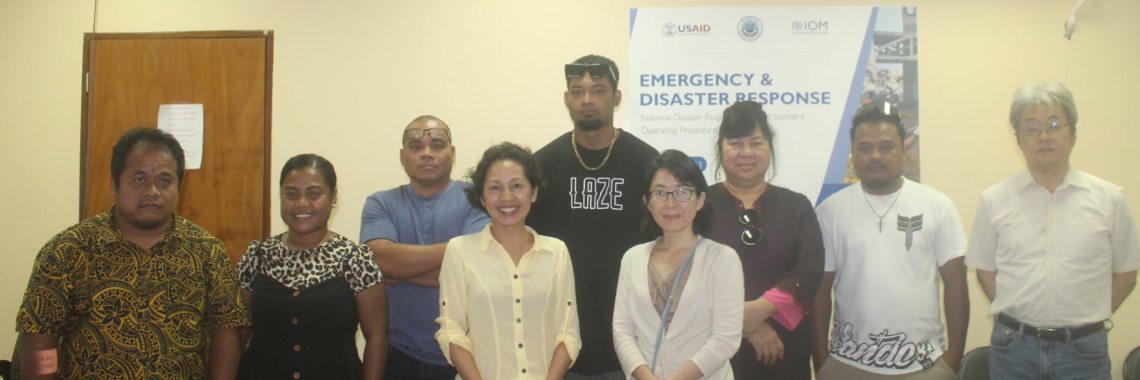
The Institute for Global Environmental Strategies (IGES), in collaboration with the Department of Environment, Climate Change and Emergency Management (DECEM), and the Climate and Clean Air Coalition (CCAC), organised a workshop to strengthen methane management in the Federated States of Micronesia (FSM). The workshop targeted national and state-level government officials to build technical capacity and institutional readiness for methane mitigation so that they will be able to review the draft methane mitigation roadmap. This workshop supports FSM’s climate goals under the Global Methane Pledge and contributes to the country’s broader efforts toward sustainable, low-emission development.
Key objectives included:
- 1. Enhancing participants’ understanding of methane emissions, including their sources, impacts, and current emission levels in the waste, agriculture, and energy sectors.
- 2. Emphasising the importance of ground-level data collection aligned with IPCC estimation methodologies.
- 3. Facilitating discussions on state-level methane reduction targets and sector-specific mitigation strategies.
- 4. Introducing digital tools and approaches to develop a robust Monitoring, Reporting, and Verification (MRV) system tailored to FSM’s context.
- 5. Recommending a feasible and effective MRV system suitable for national and subnational implementation.
The workshop combined expert-led lectures and interactive group discussions to ensure active engagement and knowledge exchange.
Outcomes:
- Improved understanding of methane emission sources and their impacts in FSM.
- Enhanced technical skills in IPCC-based estimation methods and data system management.
- Initial development of realistic methane reduction targets and draft MRV framework proposals.
- Strengthened collaboration between national and state-level stakeholders to support coordinated methane mitigation efforts.
Session 1: Current Methane Emissions and Proposed Reduction Targets and Measures by Sector and State
Ms. Miho Hayashi (IGES) presented key methane sources in FSM—solid waste disposal, wastewater, and manure management—and outlined proposed reduction targets by state. A scenario analysis was explained to show how much reduction is possible if all states implement their Solid Waste Management Strategies with better management of the Fukuoka Method landfill sites. Due to data gaps, wastewater and manure sectors were not analysed. Two main mitigation pathways were discussed: diverting organic waste from disposal sites through composting and/or biodigesters and improving landfill operations.
Session 2: IPCC Guidelines and Importance of Ground Data Collection
Mr. Kiyoto Tanabe, an IPCC expert from IGES, delivered a technical presentation on the IPCC guidelines for estimating methane emissions. He emphasised the critical role of ground-level data collection in producing accurate and credible national greenhouse gas inventories. The session highlighted the three-tier methodology under the IPCC framework. Mr. Tanabe stressed that improved local data collection and management are essential for FSM to advance toward higher-tier estimations, particularly in sectors like waste, agriculture, and wastewater, where data gaps are significant. The session reinforced the need for capacity building and institutional support to enhance emission estimation quality in FSM.
Session 3 – Useful Digital Tools for Data Management and Emission Calculation
In the afternoon session, Mr. Faafetai and Ms. Nirmala Menikpura (IGES) joined online to introduce digital tools that support methane data collection and emissions estimation. The session focused on two key tools: KoboTool, a user-friendly platform for field data collection, and the Emission Quantification Tool (EQT) of IGES-CCET, designed for estimating methane emissions from waste management sector. Participants explored sector-specific data requirements and discussed how these tools could be adapted to FSM’s local context. The discussion highlighted the importance of using digital tools to improve data accuracy, accessibility, and efficiency in developing a robust MRV (Measuring, Reporting, and Verification) system. Questions were raised about internet access, technical training needs, and integration with existing systems. The session concluded with group reflections, summarising lessons learned throughout the day and reinforcing the importance of tailored digital solutions for FSM’s methane mitigation strategy.
Session 4 – Introduction of MRV Systems
The second day began with a recap of Day 1, followed by Mr. Kiyoto Tanabe introducing MRV systems aligned with FSM’s Nationally Determined Contributions (NDCs). The session emphasised the need for accurate CH₄ emission tracking through proper data collection policies and digital tools like KoboTool and EQT. Mr. Tanabe shared practical guidance on state-level implementation. States raised concerns about limited tools, such as the absence of a weighbridge in Kosrae, and all requested KoboTool training.
Roles for data tracking were discussed: EPA in Yap and Pohnpei, and KIRMA in Kosrae, with data to be shared with DECEM. However, DECEM noted its current lack of capacity to compile inventories, pending consultant support.
The workshop concluded with closing remarks from Ms. Lucille Apis-Overhoff (DECEM), who thanked all participants for their active engagement and emphasised the importance of the project for FSM. Dr. Kumara, on behalf of IGES, also expressed appreciation to the attendees. The event ended on a positive note with a group photo, including both in-person and online participants, marking the collaborative spirit of the workshop.
Event Details
DECEM Conference Room & Online Participation
IGES Sustainable Consumption and Production Area
IGES Centre collaborating with UNEP on Environmental Technology (CCET)
2108-11 Kamiyamaguchi, Hayama, Kanagawa, 240-0115 Japan
E-mail: [email protected]
Presentation Materials
| Session 1 | PDF (557KB) | ||
| Session 2 | PDF (2.0MB) | ||
| Session3 EQT | PDF (4.2MB) | ||
| Session3 kobotool | PDF (3.8MB) | ||
| session 4 | PDF (423KB) |
Photo