
Cooperation on research and model projects to improve air quality in China:
The Japan-China Inter-city Cooperation Project for air quality improvement in China was implemented from FY2014 under a previous framework, and was completed at the end of FY2018. The results of that project were published on the website of the Ministry of the Environment Japan in March 2019. Phase 2 Cooperation (Cooperation on research and model projects to improve air quality in China) began in FY2019, based on the “Agreement on cooperation to conduct research and implement model projects to improve air quality” which was signed by the Environment Ministers of Japan and China on 23 June 2018 in Suzhou City, China.
Under this cooperative agreement, research and model projects to improve air quality in China are selected and implemented with a view to ensure the following:
- (1) Impact on policies and specific contribution to better air quality
Research and model projects must meet the requirements designated in China’s three-year action plan to win the battle for a blue sky, and must contribute to achieving policies designated in the action plan as well as showing what specific contributions would be made to improve air quality. - (2) Co-benefits for greenhouse gas emissions reduction
Research and model projects must show that they have specific co-benefits. - (3) Contribution by Japanese environmental technologies and facilities
When implementing model projects and/or pilot projects, Japanese (advanced) environmental technologies and facilities should be introduced, to ensure the presence of Japan’s contribution to air quality improvement or greenhouse gas emissions reduction. - (4) Others
Achievements and results of the research and model projects should exhibit the potential be disseminated in China and other countries across Asia.
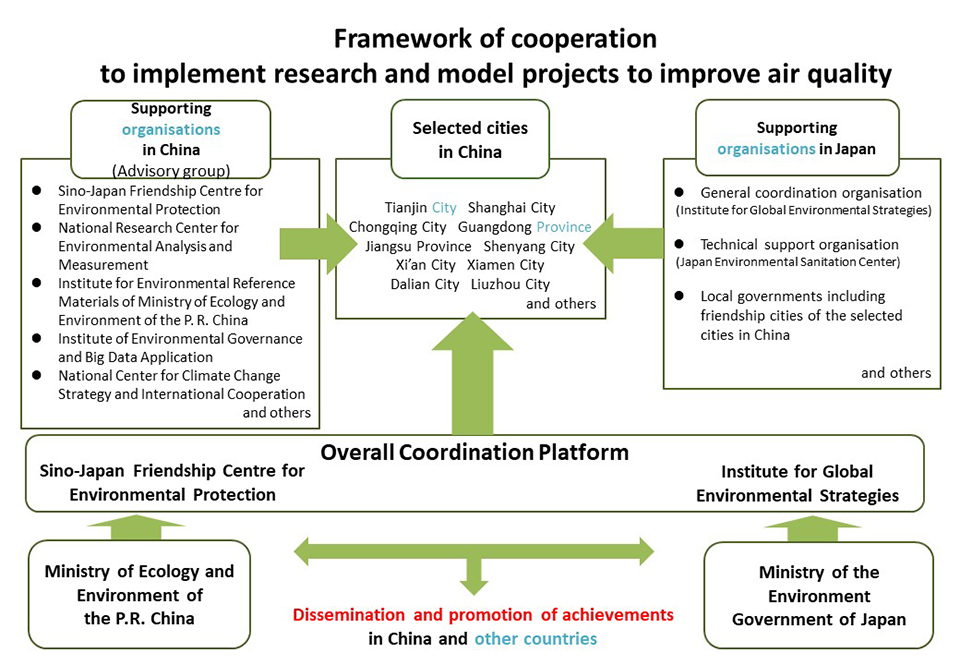
The aim is to carry out this research and implement model projects to meet all or most of the above conditions (note: hopefully meeting all conditions) in 10 designated provinces/cities (Tianjin City, Shanghai City, Shenyang City, Dalian City, Jiangsu Province, Guangdong Province, Xi’an City, Xiamen City, Chongqing City and Liuzhou City) and in other cities in China, and to this end, IGES is coordinating discussions with related entities in Japan and China and moving forward with model projects agreed on by both sides.
As of 1 April 2020, the following seven model projects are being implemented.
- 1. Model project on energy conservation and reduction of air pollutant emissions by introducing new technology to recover and reuse exhaust heat
- 2. Model project on measures for reduction of particular matters by integrated use of residual stems from crops
- 3. Model project on measures for small-scale distributed sources of air pollution in restaurant industry
- 4. Model project on reduction of VOC emissions from manufacturers
- 5. Model project on CO2 emissions reduction by integrated use of household waste
- 6. Model project on energy conservation and reduction of pollutant emissions in textile dyeing industry
- 7. Research on measures for wide-area ozone pollution in priority areas