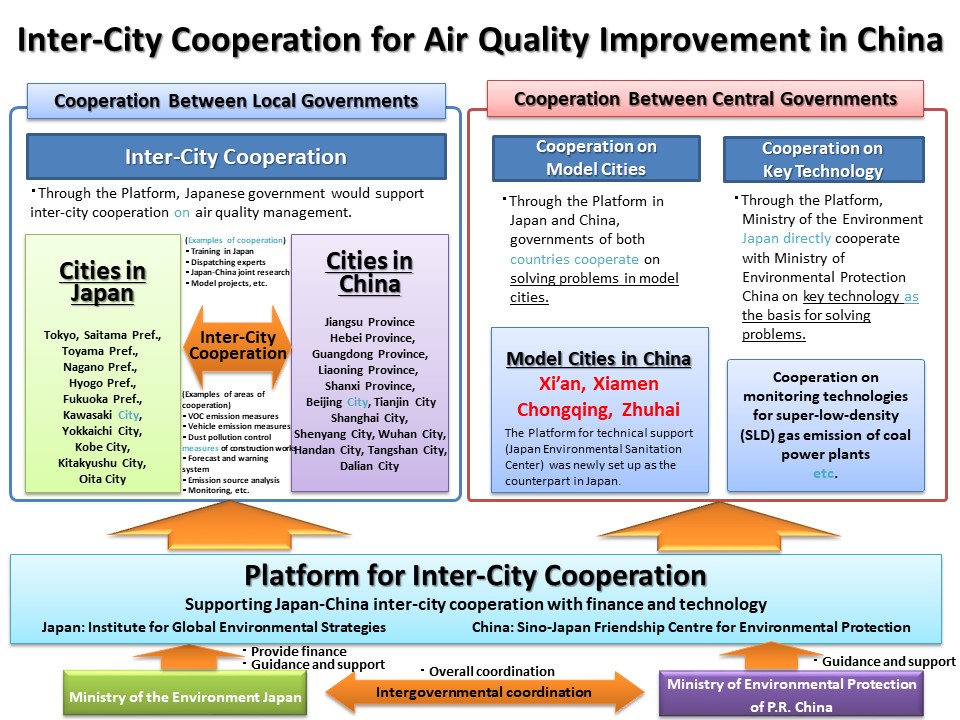

About Japan-China Inter-city Cooperation Project

The Japan-China Inter-city Cooperation Project aimed to improve air quality in China and was implemented by Ministry of the Environment Japan from FY2014. It was based on the existing good relationship between Japan and China that included friendship city initiatives, and promoted further cooperation and exchanges between cities in both countries on measures to tackle air pollution. Making use of the knowledge and know-how accumulated by experienced entities mainly made up of local governments in Japan, cooperative activities focused on human resources development and capacity building in major cities across China.
The cooperation project was implemented based on the following ideas.
- The basic concept of the project was to strengthen and develop the existing relationship between the cities in both countries (for example, friendship city initiatives) on measures to tackle air pollution. Cities without such ties wishing to form a new relationship, could do so with the help of services and coordination provided by the Platform for Inter-city Cooperation, and thus strengthen and develop cooperation on air pollution measures.
- National governments (Ministry of the Environment Japan and the Ministry of Environmental Protection of the P.R. China) provided guidance, advice, coordination and services directly or indirectly through the Platform so as to promote cooperation between the cities in both countries (“inter-city cooperation”). The necessary budget to support funding was provided by the Ministry of the Environment Japan to the extent possible.
- Cities with existing cooperative agreements continued to bear any costs. However, in cases where new cooperation was implemented to fight air pollution (including strengthening of existing cooperation), part of the costs (mainly direct costs) was provided by the Ministry of the Environment Japan.
-
Inter-city cooperation consisted of the following two components.
(1) Exchange and cooperation between government officials in each city (including officials at research institutes, foundations and public corporations under the government, known as “shiyedanwei” in China) - (2) Exchange and cooperation between private companies located in each city
-
To implement exchanges and cooperation between private companies, city governmental officials and the Platform organisations provided coordination and support, in close communication with the Network for cooperation to improve air pollution in China(*) , with the Japan-China Economic Association serving as secretariat.
(*) Please also refer to https://www.jc-web.or.jp/publics/index/126/ (Japanese) -
Establishment of the Platform and its role
(1) In order to promote inter-city cooperation, a Platform was set up comprised of organisations designated by Ministry of the Environment Japan and the Ministry of Environmental Protection of P.R. China. - (2) The Platform followed guidance and advice from both countries to:
- 1) Provide support for each city to implement inter-city cooperation
- 2) Provide coordination
- 3) Manage and execute funds
- 4) Others
Details of cooperation
What kind of cooperative action would be taken was decided in detail through discussions between the cities, based on the following principles.
- (1) Importance and priority was put on specific areas of cooperation indicated by the Chinese cities
- (2) Consideration should be given whether the Japanese cities could deal with the specific area of cooperation
- (3) If (1) and (2) do not match, the Platform worked to provide the necessary coordination to facilitate implementation of specific actions in (1).
The Institute for Global Environmental Strategies (IGES) was commissioned by the Ministry of the Environment Japan, to be the Platform organisation in Japan from FY2014 to support the framework of this project. As a result of discussions with the Ministry of Environmental Protection of P.R. China, the Sino-Japan Friendship Centre for Environmental Protection under the Ministry of Environmental Protection of P.R. China was designated as the Platform organisation in China. The Platform provided support for each city to implement inter-city cooperation, carried out coordination, and worked to manage and execute funds.
As of 1 October, 2016, 11 local governments in Japan (Tokyo metropolitan government, Saitama Prefecture, Toyama Prefecture, Nagano Prefecture, Hyogo Prefecture, Fukuoka Prefecture, Kawasaki City, Yokkaichi City, Kobe City, Kitakyushu City, and Oita City) and 17 local governments in China (Beijing City, Tianjin City, Shanghai City, Shenyang City, Wuhan City, Handan City, Liaoning Province, Jiangsu Province, Hebei Province, Guangdong Province, Shanxi Province, Tangshan City, Dalian City, Xi’an City, Xiamen City, Chongqing City, and Zhuhai City) were participating in this framework. The Framework is expected to expand in the future to include other interested cities.